The Landes forest massif imposes its own rules on tent campers. Sandy, draining soil covered with maritime pines, and a high fire risk in summer: choosing a pitch is not just about proximity to the ocean or the number of stars of the campsite. Here, we detail the ground criteria and areas that make the difference between a successful stay and a week under a blazing sun, with no recourse possible.
Forest fire regulations and bivouacking in the Landes: what conditions everything else
The Landes department enforces strict restrictions as soon as forest fire vigilance turns red. Isolated camping and bivouacking may then be prohibited in and around woods, forests, and heathlands, by prefectural or municipal decree. This constraint effectively eliminates wild camping as a reliable option during high season.
We recommend systematically checking the current decrees in the targeted municipality before booking. Some campsites temporarily close their bare pitches during peak risk periods, without this information being reflected on booking platforms. The reflex: call the campsite directly to confirm the actual opening of the tent area on your dates.
This seasonality of opening constitutes a recurring trap. Some establishments display available pitches online while only the rental part (mobile homes, chalets) operates during the concerned period. The safest window for a tent pitch for nature camping in the Landes remains the window from June to mid-July and September, excluding heatwave episodes.
Shade and size of pitches: the real comfort criteria under a tent
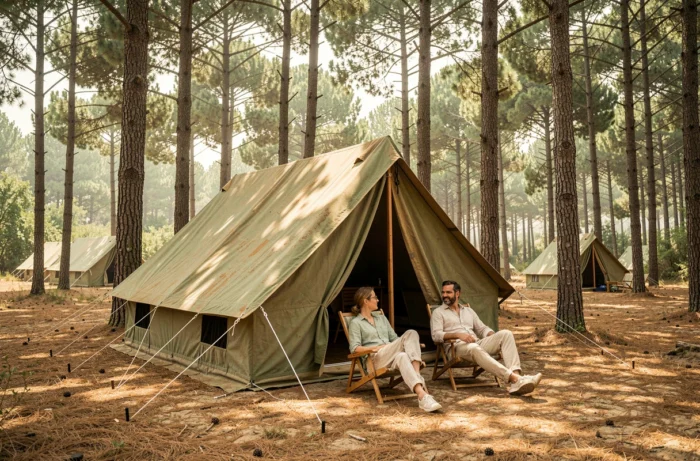
In the Landes, the canopy of maritime pines produces high, filtering shade but is insufficient during peak hours. A semi-shaded pitch of 80 to 100 m² radically changes the experience compared to a fully south-facing plot of 60 m².
Several nature campsites in the department highlight spacious pitches under forest cover as their main selling point. This positioning is not cosmetic: on sandy soil, the heat radiated from the ground accumulates quickly. Without sufficient shade, the temperature under the canvas quickly exceeds the comfort threshold from 10 a.m. in July.
What to check before booking
- The nature of the soil: pure Landes sand drains well but does not hold standard pegs well. Plan for long stakes (at least 30 cm) or V-shaped sand pegs.
- The orientation of the pitch: west-facing pitches receive the setting sun directly, while east-facing ones benefit from the natural shade of the pines in the afternoon.
- The density of the cover: a pitch “under the pines” can refer to either a dense area or a sector where three spaced trees let most of the sunlight through. Satellite photos of campsites are often more reliable than commercial descriptions.
Bare pitches or equipped tents: two distinct stay logics
The tent segment in the Landes clearly splits into two markets. On one side, bare pitches starting from €15 to €17 per night, which remain the most economical format for self-sufficient campers. On the other, equipped tents like glamping with kitchens and private bathrooms, whose rates are closer to those of entry-level mobile homes.
For a strictly nature stay, the bare pitch remains the coherent formula. It requires self-sufficiency in equipment but offers a freedom of setup that pre-erected tents do not allow. You choose your orientation, your distance from neighbors, your relationship with the vegetation.
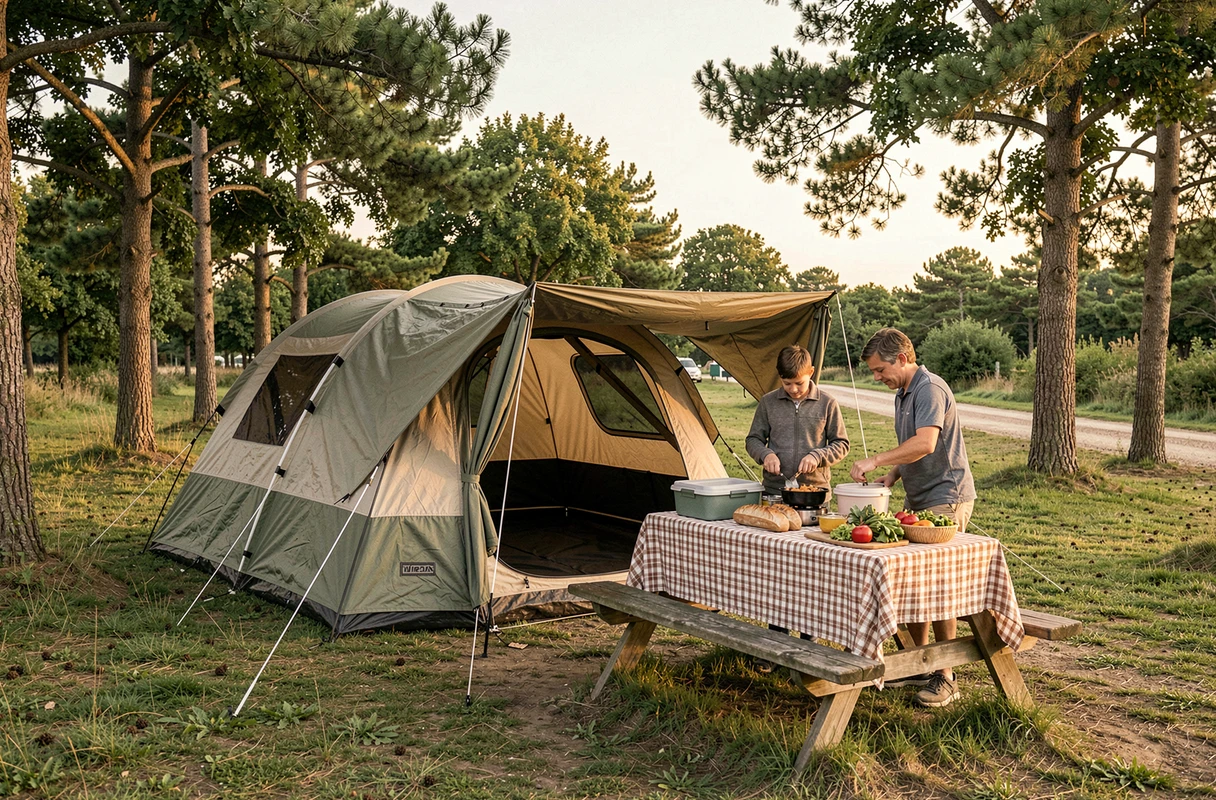
Equipped tents are suitable for campers who want the forest setting without the logistics. Some campsites offer “duo tents” or canvas-and-wood tents for four to five people, with a real bed and a covered awning. The experience has little in common with traditional tent camping, but it meets a growing demand for comfort in the great outdoors.
Geographical areas of the Landes: coast, lakes, or forest hinterland
The Landes coastline concentrates the majority of the camping offer. Proximity to the ocean, beach access on foot, surf atmosphere: it is the default choice. The concrete downside: higher camper density and often smaller pitches in structures close to the shore.
Campsites located around the lakes (Sanguinet, Biscarrosse, Parentis) offer an interesting compromise. Freshwater is accessible for paddleboarding or canoeing, pitches are generally more generous, and noise levels decrease significantly compared to coastal areas.
The forest hinterland, the least documented segment
Structures located away from the coast, in production forests, are rarely referenced in comparisons. However, they offer some of the quietest pitches in the department, with dense forest cover and lower rates. The compromise: the beach is twenty to thirty minutes away by car, which excludes daily round trips on foot.
- Coast: suitable for short stays focused on surfing and the beach, but expect high density in July-August.
- Lakes: good balance between gentle water activities, space, and relative calm, ideal for families.
- Hinterland: the best tranquility/price ratio for self-sufficient campers who prioritize the forest over ocean swimming.
The choice of geographical area weighs as heavily as the choice of the campsite itself. A crowded four-star coastal site in August will offer a nature experience far inferior to a half-empty two-star forest site the same week. The actual occupancy density takes precedence over the star rating for those seeking a true tent stay in the heart of the Landes nature.