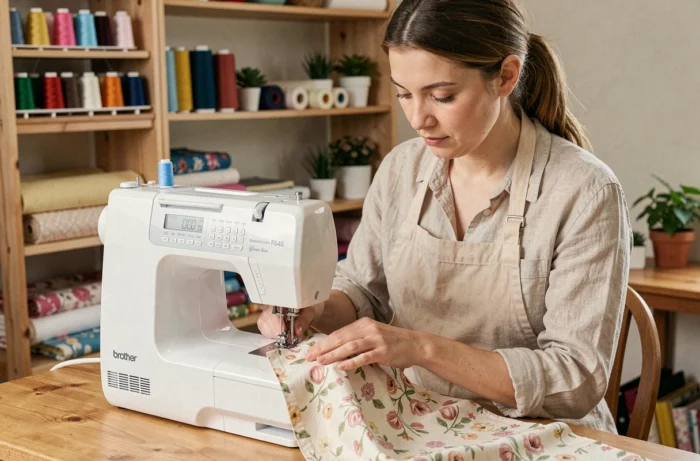
The Brother FS40 is among the best-selling electronic sewing machines in France for several years. Its accessible price positioning and digital features initially earned it a reputation as a beginner’s machine. Recent feedback shows a broader user profile that goes beyond just learning to sew.
Brother FS40 and legal warranty: a more protective legal framework
A factor rarely highlighted in product tests concerns the evolution of consumer law. Since the reform that came into effect in 2022, the legal guarantee of conformity remains two years for household appliances, with a presumption of defect origin throughout the period for new goods.
In practical terms, if the machine breaks down within the first two years, it is up to the seller to prove that the defect did not exist at the time of purchase. This reversal of the burden of proof changes the game for buyers who are hesitating between a new machine from a recognized brand and a second-hand or unbranded model.
The European directive 2024/1799 on the right to repair, applicable from July 31, 2026, to certain families of products, reinforces this logic. It requires manufacturers to maintain the availability of spare parts and to offer repair solutions.
For a brand like Brother, whose distribution and after-sales service network covers French territory, this is a tangible argument against less well-established competitors. Those looking to learn more about the Brother FS40 will find a comprehensive overview of its technical features.
Sewing thick fabrics with the Brother FS40: where is the limit
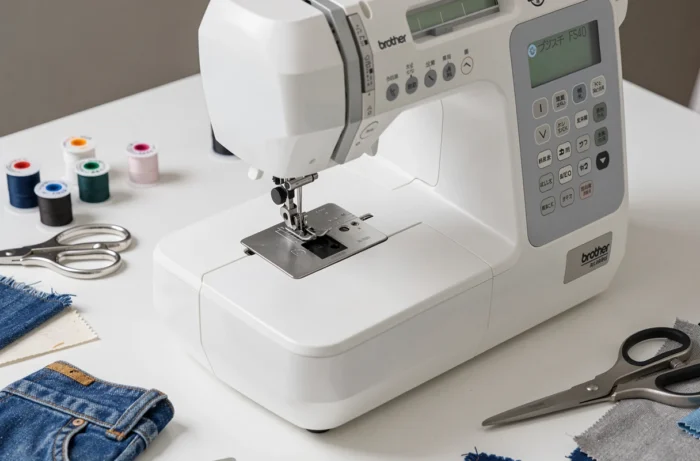
Sewing forums are full of discussions about this machine’s ability to handle thick materials. Lightweight denim, fine oilcloth, and certain faux leathers pass under the presser foot without major difficulty. However, user feedback diverges on this point as soon as multiple layers of denim are stacked or genuine leather is attempted.
The FS40 features drop feed dogs and a stitch length adjustment that goes up to 5 mm, with an adjustable width of up to 7 mm. These parameters provide a reasonable margin for various projects. The motor, sized for a consumer machine, reaches its limits on thicknesses that would require semi-industrial mechanics.
A recurring testimony in sewing groups concerns the making of bags. The handles, which concentrate several layers of reinforced fabric, sometimes cause vibrations or a machine stop. This is not a design flaw, but a reminder that the FS40 is intended for versatile domestic sewing, not artisanal leather goods.
What the machine accepts and what it refuses
- Cotton, linen, poplin, lightweight jersey: no problem, the machine handles these materials consistently across all 40 available stitches
- Single-layer denim, fine oilcloth, soft faux leather: satisfactory results as long as speed is reduced and an appropriate needle is used (type 90/14 or 100/16)
- Overlapping denim, genuine leather, thick straps: risk zone, the machine may vibrate, skip stitches, or jam
Brother FS40 as a progression machine: beyond the first project
The FS40 has long been labeled as an entry-level machine. Recent analyses present it more as a smart investment for advancing in practice, rather than just a low-budget discovery purchase.
Its 40 programmable stitches cover almost all common needs: straight stitches, zigzag, decorative stitches, automatic buttonhole. The LCD screen and automatic needle threading reduce preparation time, which matters when sewing regularly and not just for the occasional hem.
The maximum speed is reported to reach about 400 stitches per minute. This rate allows for sustained work on medium-sized projects (clothing, accessories, home textiles) without the machine becoming a hindrance. The integrated speed control offers gradual control, useful for delicate passages or tight curves.
A weight that favors mobility
Weighing around 5 kg, the FS40 is easily transported from room to room or during group workshops. This compact format partly explains its success among sewers who use it as a second workstation, alongside a heavier machine reserved for demanding projects.
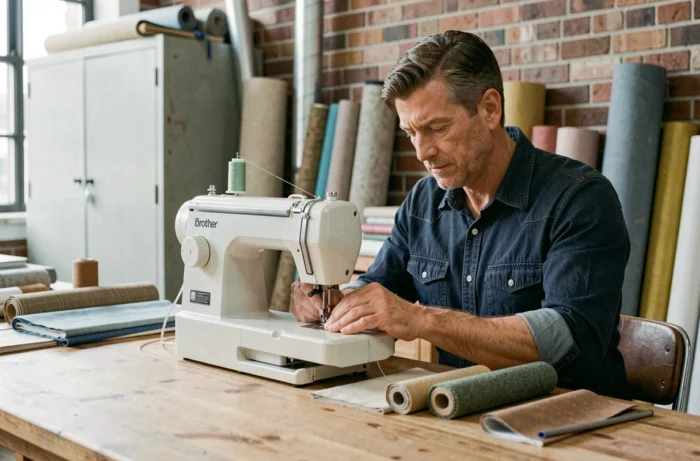
Price positioning of the Brother FS40 compared to Singer and Janome machines
Price remains the primary purchasing criterion for most sewers who are starting out or returning to sewing after a break. The FS40 is positioned in the lower range of electronic machines, putting it in direct competition with some intermediate range mechanical models from Singer or Janome.
The difference lies in the embedded electronics. At a comparable budget, a mechanical machine generally offers fewer stitches, no screen, and manual threading. The FS40 incorporates these digital features without significantly increasing the price, which explains its attractiveness in online comparisons.
The available data does not allow for conclusions about long-term durability compared between these brands. User feedback on the FS40 reports few mechanical failures in the first years of use, but testimonials beyond five years of intensive use remain rare. The current legal framework (two-year warranty, right to repair) mitigates this risk for buyers who prioritize a brand with a structured after-sales service network.
The Brother FS40 appeals because it occupies a specific niche: sufficiently equipped not to frustrate, yet accessible enough not to pose a financial risk. Its growing success is less about exceptional quality and more about a well-calibrated balance between price, features, and perceived reliability in a segment where comparable alternatives are few.