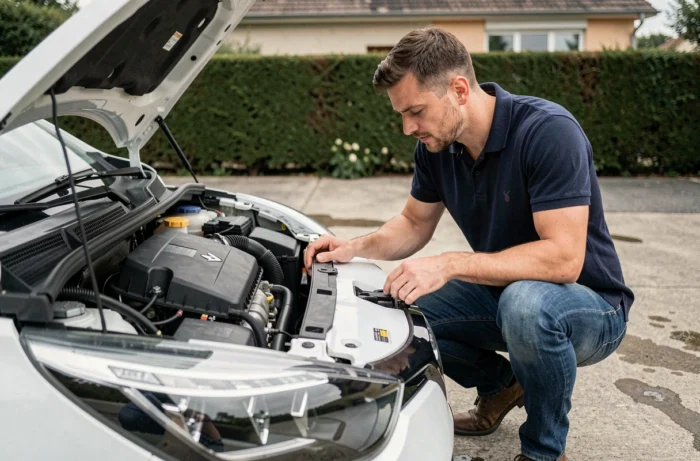
On the Clio 5, the message “injection to be checked” does not necessarily indicate a mechanical failure. The 1.0 SCe and 1.0 TCe engines feature fine electronic management of the air-fuel mixture, and the engine control unit (ECU) triggers an alert as soon as a parameter goes out of its tolerance range. Before making an appointment with a mechanic, several checks can be performed without specialized tools.
OBD2 Fault Codes on Clio 5: Read and Interpret Yourself
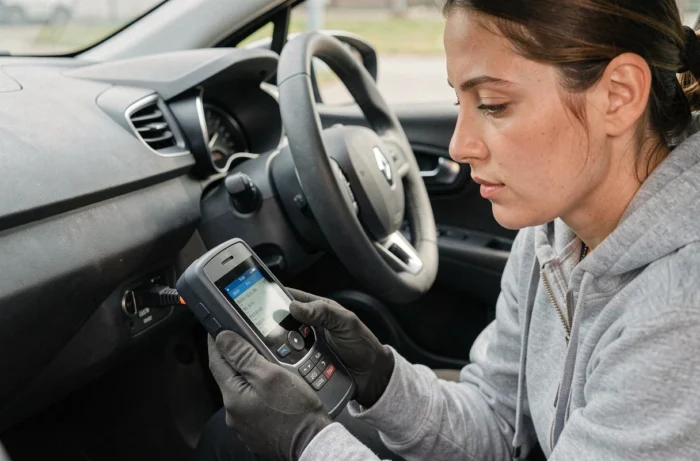
The first useful operation is to connect an OBD2 reader to the diagnostic socket located under the steering wheel on the driver’s side. Bluetooth or Wi-Fi dongles compatible with ELM327 are inexpensive and can be paired with a mobile app (EOBD Facile, Torque, Car Scanner). Within seconds, the DTC code stored by the ECU is displayed.
On the 1.0 TCe engines, we frequently observe codes related to the combined management of injection and turbo, especially when the vehicle is mainly driven in the city and the engine does not reach its optimal temperature. A code like P0300 (random misfires) or P0171 (too lean mixture) already guides the diagnosis.
Before you start checking the injection of your Clio 5, note the exact code and its status (permanent or intermittent). An intermittent fault that is cleared and does not return after several driving cycles often indicates an isolated incident, not a material failure.
Injection Fault on Clio 5 Petrol: Software Origin Before Hardware
One point that mainstream articles overlook: the problem is sometimes purely software-related. Renault has corrected injection behavior causing dashboard alerts through ECU updates, including on the Clio IV generation. This trend continues with the Clio 5.
Specifically, a visit to a Renault agent allows you to check if an ECU update is available for your vehicle. This intervention does not require any part replacement and corrects injection maps that are unsuitable for certain usage conditions (repeated short trips, variable quality fuel).
We recommend asking the technician about this before any mechanical intervention. A reprogramming can sometimes resolve cold stuttering or intermittent power losses that neither injector cleaning nor sensor replacement would have fixed.
Sensor and EGR Valve on Clio 5: Accessible Visual Checks
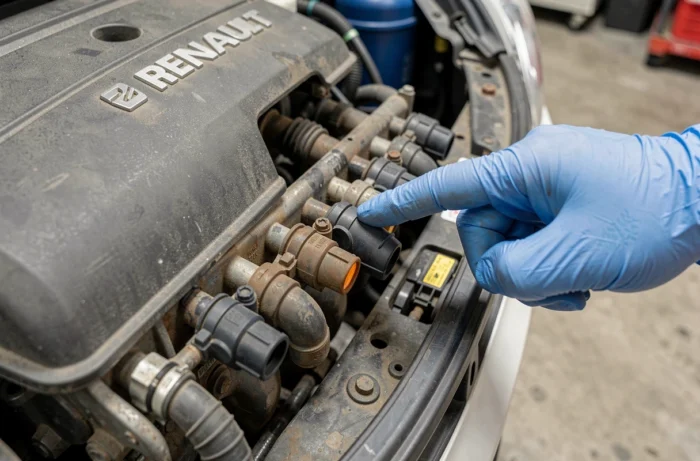
On the 1.0 SCe and TCe engines, three elements trigger the majority of injection alerts and can be inspected without removing the engine:
- Intake Manifold Pressure Sensor (MAP): check its electrical connector. A loose connection or moisture on the plug is enough to generate a fault code. Disconnect, clean with contact cleaner, reconnect.
- EGR Valve: on petrol versions, it clogs less quickly than on a diesel, but exclusive urban use accelerates the accumulation of residues. An EGR valve cleaner sprayed into the intake can restore normal operation.
- Upstream Lambda Sensor: an oxidized connector or a cable rubbing against the exhaust manifold skews the air-fuel ratio measurement. A visual check of the wiring takes a few minutes with the hood open.
If the connector is clean and the wiring intact, the fault points to the component itself. The DTC code read in OBD2 then allows you to target the part to be replaced without guesswork.
Fuel Filter and Fuel Quality
Poor maintenance can also trigger the injection warning light. A clogged fuel filter or refueling at a station with sediment in the tank disrupts rail pressure. On a direct injection petrol engine, the tolerance for impurities is very low.
Check the date of the last fuel filter replacement in your maintenance log. If it exceeds the interval recommended by Renault, replacing it is a simple and inexpensive first maintenance step.
Injection Diagnosis Clio 5: When the OBD2 Tool is No Longer Enough
The consumer OBD2 reader reads generic codes (P0xxx). It does not cover specific Renault manufacturer codes (DF xxx), which represent a significant portion of the faults reported on Clio 5s. To go further, you need a tool compatible with the Renault protocol, such as Clip (the official tool) or third-party alternatives capable of reading specific CAN frames.
The boundary between what you can do and what requires a professional is precisely there. Reading a generic code and checking a connector requires no special skills. Interpreting a manufacturer code, measuring rail pressure, or testing an injector on a bench requires dedicated equipment.
Cold Stuttering on 1.0 TCe: A Recurring Symptom
Recent feedback on the Clio 5 petrol describes stuttering during acceleration when cold, sometimes accompanied by temporary power loss. This behavior particularly affects vehicles used in urban settings, where the engine rarely runs long enough to reach its operating temperature.
On a small turbo engine, the warming phase simultaneously engages the injection, wastegate, and ignition mapping. Regular driving on the road (stabilized RPM, engine temperature reached) helps limit clogging and space out injection alerts.
The message “injection to be checked” on the Clio 5 is resolved in most cases by a basic OBD2 diagnosis, a visual check of the connectors, and a review of the maintenance schedule. Reserve workshop visits for manufacturer codes and pressure measurements. The rest can be managed from your smartphone and a screwdriver.