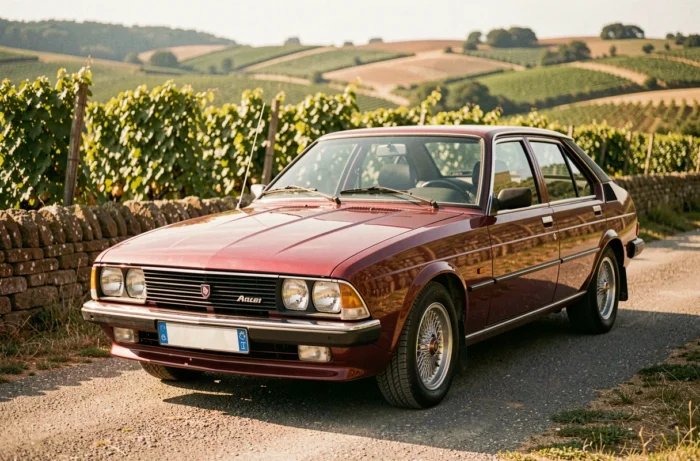
The Renault 30 is often presented as a V8 engine sedan on the pages dedicated to it. This designation is misleading: the engine that defined this model is a 2,664 cm3 PRV V6, the result of a collaboration between Peugeot, Renault, and Volvo. Understanding the actual technical specifications of this French saloon from the 1970s-1980s involves untangling what is myth and what the mechanical data confirms.
Renault 30 TX: engine and transmission data compared to the competition
The most advanced version of the model remains the Renault 30 TX, which appeared at the end of 1978 with the adoption of Bosch K-Jetronic injection. This evolution allowed for increased power and reduced consumption compared to the carbureted versions.
| Characteristic | Renault 30 TX (1979) |
|---|---|
| Engine | PRV V6, 2,664 cm3 |
| Power | 142 hp |
| Torque | 215 Nm |
| Transmission | Front-wheel drive |
| Gearbox | 5-speed manual or 3-speed automatic |
| Weight | 1,340 kg |
| Top speed | 188 km/h |
These figures place the Renault 30 TX among the top tier of French sedans of the time. 142 hp for 1,340 kg provided a decent power-to-weight ratio, though it did not reach the performance levels of German saloons in the same segment.
The technical sheet of the Renault 30 V8 details the complete specifications of the model, including the various model years that marked its production.
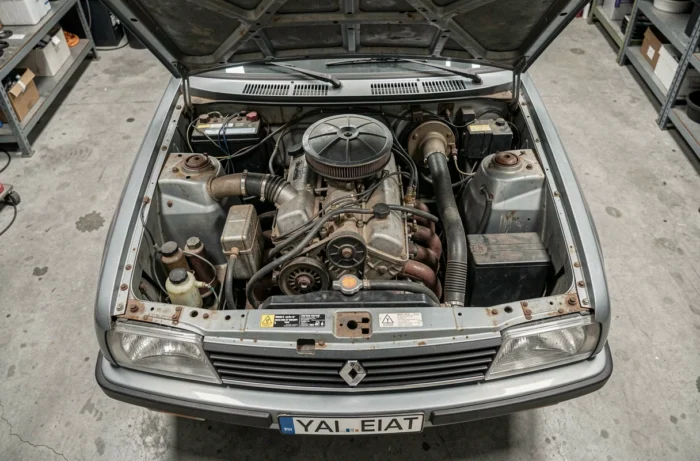
Bosch K-Jetronic Injection: what really changes on the Renault 30
Before the arrival of K-Jetronic injection, the early Renault 30 TS (from 1975) used carburetors. The switch to continuous mechanical injection represented the most significant technical evolution of the model.
The K-Jetronic system continuously meters fuel using a plate sensor that measures the intake air flow. This technology, common among German manufacturers at the same time, offered two concrete advantages:
- Better cold operation consistency, where carburetors required longer warm-up times and frequent misfires
- A reduction in consumption during regular use, although it could still reach around 12 l/100 km depending on driving conditions
- A power gain compared to the carbureted TS version, thanks to a more precise air/fuel mixture at all engine speeds
For enthusiasts considering a restoration, the availability of K-Jetronic injection parts remains a point to monitor. However, this system, shared with other Peugeot and Volvo vehicles from the same period due to the PRV agreement, makes finding components easier.
Driving behavior of the Renault 30: comfort versus dynamism
Specialized sources emphasize a point that raw technical sheets do not convey: the Renault 30 is a car designed for cruising, not for aggressive driving. Its suspension prioritizes the filtering of irregularities, and occupant comfort takes precedence over driving precision.
This philosophy is felt in the steering, which is assisted but not very communicative, and in the body roll during turns. The front-wheel-drive chassis, combined with the weight of the V6 overhang, imposes a calm driving style to stay within the vehicle’s comfort envelope.
The actual consumption in mixed use, often close to 12 l/100 km, confirms this positioning as a relaxed touring car. Motorists seeking thrills tended to turn to Alpine models from the same era.
A positioning between two worlds
Renault aimed at the large sedan segment occupied by Peugeot (604) and Citroën (CX). The Renault 30 offered a more modern engine than its French competitors thanks to the PRV V6, but struggled to convince against German sedans in terms of dynamic behavior.
Its total production of 136,403 units between 1975 and 1983 reflects moderate commercial success. The model never really broke through in exports, remaining primarily a car for the French market.
Model year evolutions of the Renault 30: details that standard sheets omit
General articles often limit themselves to the big picture. Specialized sources document detailed changes that directly interest collectors:
- As early as 1975, a right-hand drive version was offered for the British market, indicating an export ambition from the launch
- In 1976, body and equipment tweaks occurred, notably altering the interior trims and some elements of the front end
- At the end of 1978, the arrival of the TX version with K-Jetronic injection and 5-speed gearbox redefined the range
These model year variations have a direct impact on the value of vehicles in collections. A well-maintained Renault 30 TX, with its functional original injection and 5-speed manual gearbox, stands out significantly from an early carbureted TS.
V6 PRV and not V8: a precision that matters
The term “Renault 30 V8” circulates on many pages, but no production Renault 30 was equipped with a V8 engine. The PRV block is a 90-degree V6. This confusion may stem from the mental association between “high-end Renault” and “big engine,” but it misleads potential buyers looking for a specific model in the collector market.
The Renault 30 remains a concrete testament to French industrial ambition in the 1970s. Its PRV V6 has actually survived well beyond the model, equipping Peugeot, Citroën, and Volvo vehicles for over two decades. The engine lasted longer than the car that popularized it in France.