A child’s ability to project themselves into the future relies on a precise cognitive mechanism: prospective thinking, which is the ability to mentally simulate future situations. This skill, which develops gradually between the ages of three and ten, directly depends on the quality of the stimuli received, from symbolic play to conversations about professions. Supporting a child in this construction is not about motivational speech, but about concrete actions that nourish their imagination and confidence.
Prospective thinking in children: the mechanism to understand
Before wanting to inspire a child, one must understand how their projection into the future works. Prospective thinking mobilizes episodic memory, imagination, and the ability to chain causes and effects. For a four-year-old child, this chain is short: they can imagine what they will do tomorrow, but rarely in five years.
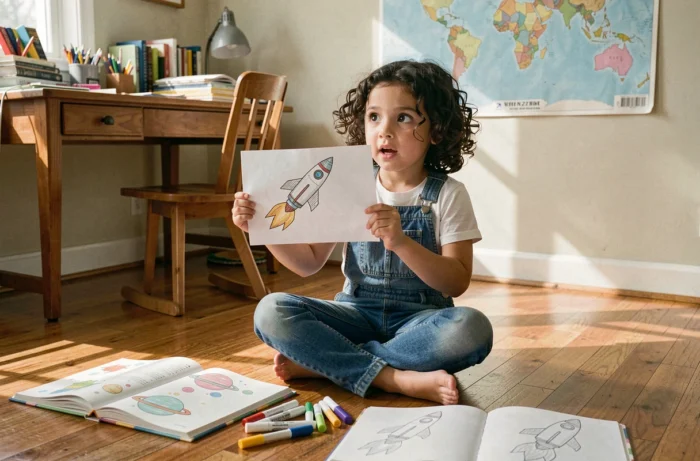
Symbolic play (playing doctor, playing shopkeeper, building a cardboard rocket) serves as the main training ground. Each invented scenario forces the child to step into the shoes of a future character, solve fictional problems, and verbalize intentions. This is not a trivial pastime: it is the very foundation of the ability to dream big.
Parents who actively participate in these games, by asking open-ended questions rather than directing the scenario, enhance the complexity of the child’s projections. Resources like quandjeseraigrande.net provide materials that feed this dynamic by showcasing a variety of professional paths accessible to younger children.
Conversations about professions: asking the right questions rather than giving answers
Most adults, when faced with a child who announces they want to become an astronaut or a dragon trainer, react in two ways: either they approve without nuance, or they redirect towards the “realistic.” Both approaches miss the point.
The goal is not to validate or invalidate a dream, but to teach the child to break down an ambition into steps. Asking “What does an astronaut do in their day, according to you?” or “What do you like about the idea of training dragons?” opens a space for reflection. The child begins to distinguish the appeal (adventure, contact with animals) from the profession itself.
This distinction is valuable. A child who understands that their attraction to space comes from scientific curiosity will later be able to orient themselves towards physics, engineering, or space biology without feeling they have betrayed their initial dream.
Three types of questions that advance reflection
- Exploratory questions: “How do you imagine your day if you did this job?” They enrich the mental representation and reveal what truly attracts the child.
- Connection questions: “Do you know someone who does something similar?” They anchor the dream in reality without reducing it.
- Action questions: “What could you try this week to get closer to it?” They transform the dream into a project, even a modest one.
Digital usage and imagination: what recent studies show
Parental concern about screens is widespread, but recent scientific data paints a more nuanced picture than the prevailing discourse. Several longitudinal studies published between 2024 and 2026 indicate that screen time does not systematically have a negative effect on the cognitive development of children and adolescents.
The distinction lies in the nature of the activity. Active uses (digital construction games, creative activities, interactive educational content) can be associated with better working memory and overall cognition. Purely passive uses (scrolling through videos without interaction) do not offer the same benefits.
The very beginning of life and the start of schooling remain sensitive periods where screens can compete with fundamental experiences: symbolic play, human interactions, oral language. The balance between sleep, physical activity, and social life matters more than the sheer volume of screen hours alone.
For a parent who wants to nurture their child’s imagination, the question is not “how much time” but “for what purpose.” A child who uses a tablet to design a video game character or virtually explore a volcano exercises their prospective thinking. One who passively watches videos on repeat does not.
Childhood dreams and school orientation: the underestimated link
Childhood dreams are not disposable whims. They leave marks in identity construction and influence, sometimes years later, the choices of orientation. A Belgian orientation barometer published by Siep in 2026 confirms that a lack of knowledge about professions remains one of the main barriers to youth orientation.
Exposing a child to a diversity of professional paths from primary school reduces this bias. Children who only have access to a limited number of role models (doctor, lawyer, footballer) build a limited imagination. Those who discover varied professions, including manual, technical, or artistic careers, develop a much broader spectrum of projection.
Building a rich environment of role models
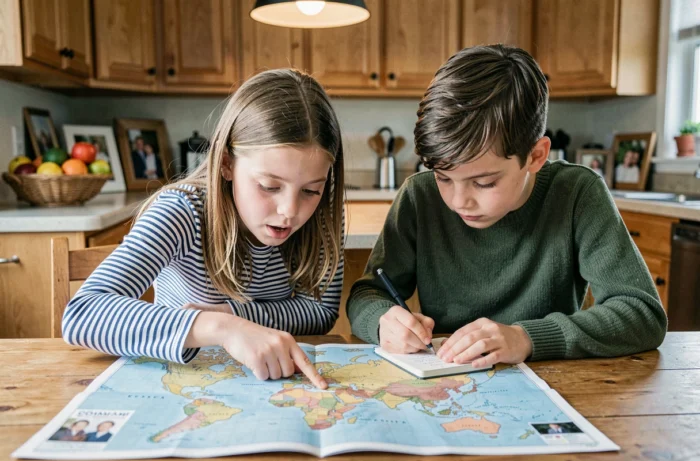
Increasing opportunities to meet adults in different professions remains the most effective method. Workplace visits, discussions with relatives about their daily professional lives, targeted readings and documentaries: each exposure adds a brick to the child’s imagination.
The goal is not to push the child towards a specific profession. It is to provide them with enough material so that their dreams are not limited by a lack of references. A child who has seen a carpenter work with wood, an oceanographer talk about their dives, and a developer explain their code has a mental repertoire that nothing can replace.
A child’s imagination feeds on concrete experiences much more than on abstract encouragement. Every in-depth conversation, every role-playing game, every encounter with a passionate professional adds a possibility to the mental map of the future. The parent’s role is not to pave the way but to multiply the visible paths.