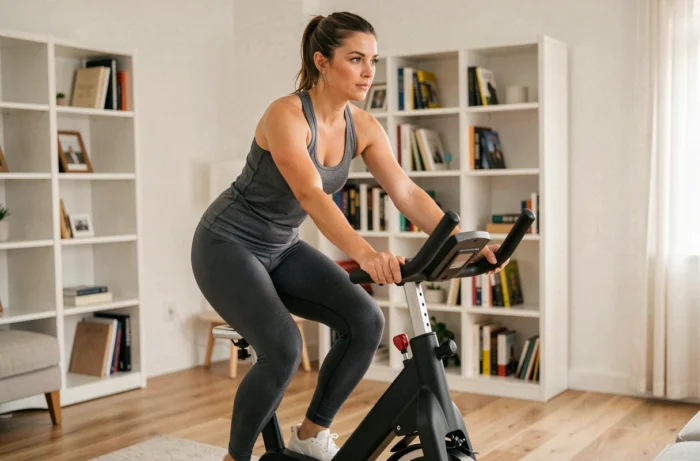
When you have a twelve-square-meter living room and want to pedal between the sofa and the coffee table, the Ultrasport F-Bike range stands out for its compact size when folded. Between the F-Bike 200B, the 350B, and the 400BS, the differences are not immediately obvious on a product sheet. However, it is the design details (backrest, resistance, sensors) that determine whether the device will hold up in daily use.
Magnetic resistance and difficulty levels: what really changes from one model to another
All F-Bikes use a manually adjustable magnetic resistance system via a knob. There are eight levels across the entire range. On paper, nothing distinguishes the 200B from the 400BS in this regard.
In practice, the difference lies in the inertia mass. The 400BS features a slightly heavier flywheel, which makes pedaling smoother at high resistance. On the 200B and the base model, the higher levels give a somewhat harsh braking sensation, especially beyond level six.
For light to moderate cardio training, the eight levels are sufficient on all models. If aiming for more intense sessions with progressive increases, the 400BS offers a more consistent pedaling experience. A comparison of Ultrasport F-Bike bikes details the differences in pedaling sensation between each model, including sensors and resistance.
Ultrasport F-Bike seat comfort: the weak point to anticipate
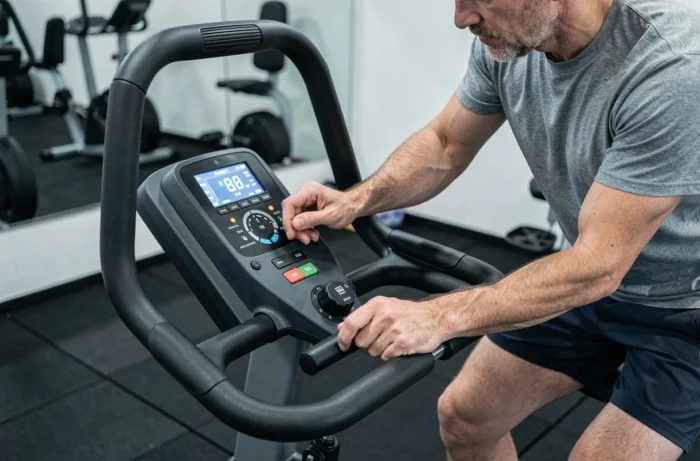
Let’s not beat around the bush: the original seat is the weak link in the entire range. User feedback overwhelmingly converges on this point. Beyond thirty minutes of pedaling, the seat becomes uncomfortable, even on the 200B which incorporates gel in the seat.
The 400BS adds a padded backrest that relieves the lower back and redistributes some of the pressure. This backrest truly changes the experience during long sessions. For models without a backrest, a separately purchased gel seat cover solves the problem for a few euros.
What session duration to aim for depending on the model
- Base F-Bike and F-Bike 150: comfortable for up to twenty minutes without modification, suitable for warm-up or active recovery use
- F-Bike 200B: the integrated gel extends the comfort window to about thirty minutes, but the seat remains narrow for larger builds
- F-Bike 400BS: the backrest allows for exceeding thirty minutes without lower back pain, making it the only model suitable for regular daily use without additional accessories
Ultrasport folding bike: actual footprint and storage constraints
Folding is the main selling point of the range. All F-Bikes fold vertically and stand upright against a wall. The floor space when folded is comparable to that of a high chair.
However, the weight varies significantly from one model to another. The base model remains the lightest, easy to move from room to room. The 400BS, with its backrest and heavier flywheel, requires a bit more effort to transport. If you store the bike after each session (common in a studio), this weight difference matters on a daily basis.
The folded locking system is identical across the range. It holds well, but feedback varies on the stability of the bike when placed against a wall on tiled floors. A small non-slip mat under the rear feet solves the problem.
Console and sensors: basic functions that get the job done
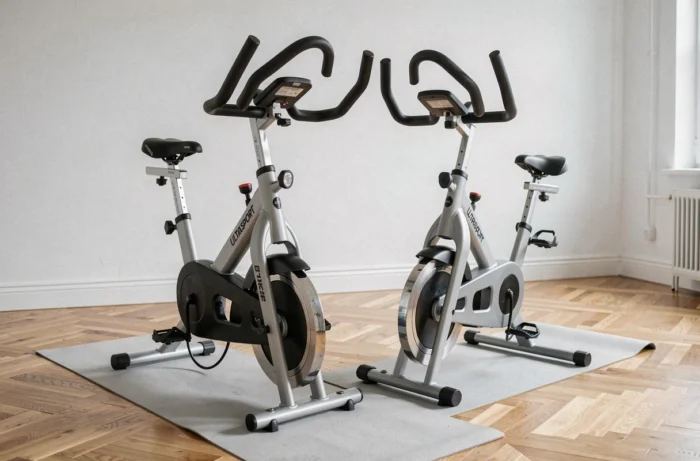
The LCD screens of the F-Bikes display time, speed, distance, estimated calories, and heart rate via palm sensors integrated into the handles. The console is not backlit, making it difficult to read in a dark room.
The palm sensors provide an approximate estimate of heart rate. For serious cardio tracking, it is necessary to supplement with a chest strap or a connected watch. The console does not connect to any fitness apps. It remains a standalone tool, without a digital ecosystem.
What the console does not do
No predefined training programs, no Bluetooth connectivity, no progress tracking between sessions. If you want to track your performance over time, you need to note it manually or use a third-party app in parallel. For simple fitness use without data obsession, this is sufficient.
F-Bike 200B, 350B or 400BS: choice table according to use
| Criterion | F-Bike 200B | F-Bike 350B | F-Bike 400BS |
|---|---|---|---|
| Backrest | Yes (small) | No | Yes (padded) |
| Gel seat | Yes | Standard | Standard |
| Resistance levels | 8 | 8 | 8 |
| Comfort beyond 30 min | Medium | Limited | Good |
| Weight (ease of storage) | Medium | Light | Heavier |
| Suitable for intense sessions | No | No | Partially |
The 350B, less visible in usual comparisons, accumulates a significant volume of reviews. It positions itself as an intermediate model for casual users who do not need a backrest and prioritize lightness.
The 400BS remains the logical choice for regular use. The 200B is suitable for those who want a backrest without upgrading, with the trade-off of slightly less smooth pedaling at high resistance.
Whichever model you choose, planning for a seat cover and a floor mat right from the purchase avoids the first two disappointments that lead to abandoning home training.