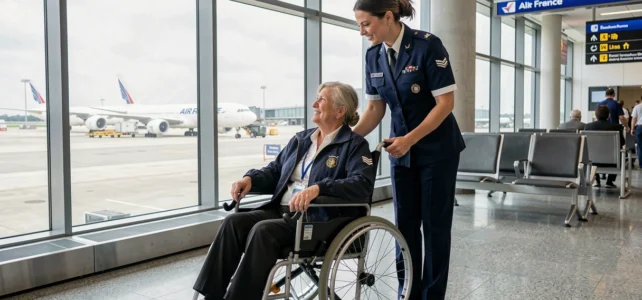
The European regulation requires airlines to provide free assistance to passengers with reduced mobility. Air France implements this obligation through a structured system, the Saphir service, which covers the entire journey, from booking to baggage collection. However, the issue of pricing regularly raises questions: is there a reduced fare for travelers with disabilities or their companions?
Free Assistance and Lack of Dedicated Disability Fare
One point must be made clear: Air France does not offer any specific fare or discount related to disability. The ticket is booked at the standard price of the chosen class, whether or not the passenger requires assistance.
What is free is the assistance service itself. Help with boarding, transport of wheelchairs or medical equipment, priority welcome: none of these services incur additional costs. The airline also does not charge for the transport of an electric wheelchair or mobility equipment in the hold, where other special services (excess baggage, animal in cabin) are chargeable.
To delve deeper into the issue of assistance and disability fares at Air France, it is essential to distinguish between two aspects: the ticket price (the same for everyone) and the assistance service (fully covered).
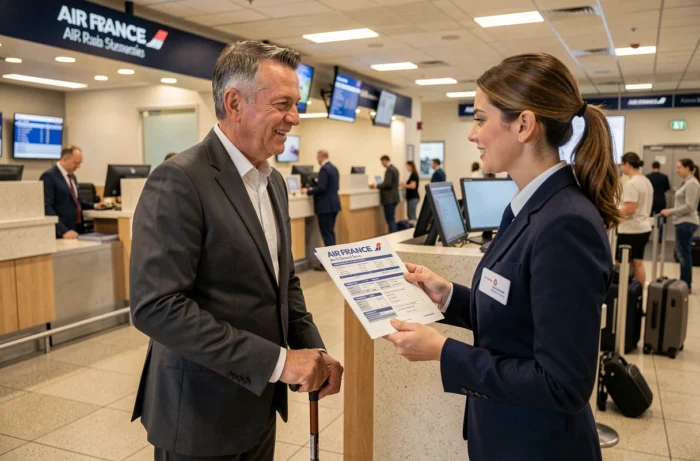
Saphir Card: A Centralized Disability Profile Valid for Five Years
The Saphir service operates as a one-stop shop dedicated to passengers with disabilities or reduced mobility. Its main tool is the Saphir card, which is free and valid for five years. It records a personalized profile: type of disability, specific assistance needs, medical equipment transported.
The concrete benefit of this profile lies in the elimination of repetitive procedures. Without a Saphir card, each booking requires resubmitting all sensitive information (need for oxygen, wheelchair dimensions, necessity for a medical companion). With the registered profile, this data is preloaded.
Contactability and Anticipated Timelines
The Saphir service is reachable from Monday to Saturday during defined hours. The request for assistance must reach Air France at least 48 hours before the departure of the first flight. In practice, the earlier the request is made, the better the airline can organize the appropriate means (ambulift, specific seat, pre-boarding).
This 48-hour notice is not unique to Air France: it stems from the European regulation governing assistance for disabled persons in air transport. However, feedback from the field varies on this point. Some passengers report that requests made within the timeframe were not properly communicated to the ground teams, raising concerns about the reliability of the information chain between booking and actual boarding.
Transport of Mobility Equipment: What Air France Really Covers
The transport of a wheelchair (manual or electric) in the hold is included at no charge and does not count towards the baggage allowance. It is a right, not a commercial favor. The airline also transports walkers, canes, and other mobility aids.
For electric wheelchairs, the procedure is more stringent. Lithium batteries are subject to strict air safety regulations. Air France requires precise information about the type of battery, its capacity, and its disconnection method. Here are the elements generally requested:
- The exact type of battery (lithium-ion, gel, acid) and its capacity in watt-hours
- The ability to disconnect the battery and protect the terminals against short circuits
- The dimensions and total weight of the wheelchair, to verify compatibility with the aircraft’s hold
An electric wheelchair incompatible with the hold may result in a refusal to board the equipment, not the passenger. The airline then provides an onboard wheelchair, but this does not replace a personal adapted wheelchair. This risk is rarely highlighted in commercial pages.
Concrete Limits of Air France’s Assistance System
The regulatory framework guarantees a baseline of rights. However, its daily implementation shows discrepancies. Several points deserve to be examined without complacency.
Information Transmission Between Services
The request for assistance passes through several intermediaries: the Saphir service, the booking system, the ground handling company (which is not always an Air France provider), and then the crew. Each link in this chain can lose or distort information. A passenger who has indicated a need for medical oxygen may arrive at boarding without the ground team being aware of it.
This problem is not theoretical. Feedback from travelers on review platforms reports situations where the reserved assistance simply did not show up, forcing the passenger to improvise or rely on the goodwill of the present staff.
Onboard Wheelchair and Reduced Autonomy
In the cabin, the personal wheelchair is replaced by a narrow onboard wheelchair designed to navigate the aisle. This wheelchair does not allow for independent movement: it requires the assistance of the cabin crew. On a long-haul flight, this dependency represents a significant constraint, particularly for access to restrooms.
Accessible restrooms are not available on all types of aircraft. On some medium-haul flights, the facilities are too narrow even for the onboard wheelchair itself.
Mandatory Companion: A Hidden Cost
In some cases, Air France may require the presence of a companion if the passenger cannot evacuate the aircraft independently in an emergency. This companion must purchase their own ticket at the standard fare. No discount is applied.
- The criterion for autonomy in emergency evacuation is assessed by the airline, sometimes via a medical form (MEDIF)
- The decision to impose a companion is not always predictable and may vary from one booking to another
- The cost of the companion’s ticket thus adds to the travel budget without fare compensation
This point constitutes a blind spot in the discourse on the free assistance. The service is free, but the trip can cost double if a companion is required.
Air France’s system remains among the most structured in Europe, thanks to the Saphir card and the centralization of profiles. The flaws lie less in the framework than in its execution, where information circulates between systems and providers that do not always share the same tools. For a passenger with a disability, preparing the trip well in advance of the regulatory deadline remains the best protection against these uncertainties.