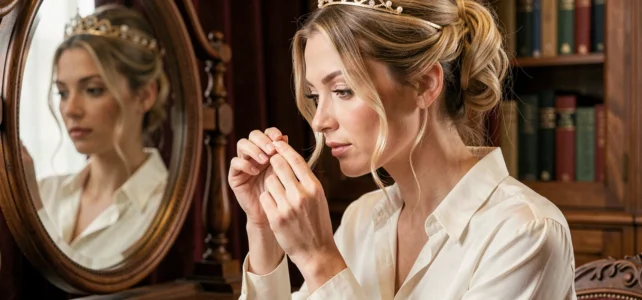
The tiara, the diadem, and the crown share a common vocabulary in head jewelry, but their structures, methods of attachment, and ceremonial uses diverge on specific points that most wedding guides overlook.
Mounting and attachment: what technically separates tiara, diadem, and crown
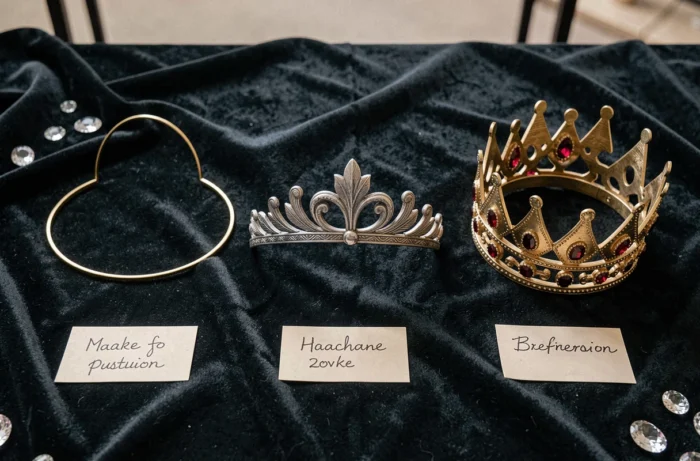
The fundamental distinction is structural. The crown is a closed circle that completely surrounds the head. It rests on the skull by peripheral support and does not require any auxiliary attachment system. The diadem and tiara, on the other hand, are open arcs that only cover the frontal part and the temples.
The diadem is characterized by a semi-rigid band, often thin, with a relatively uniform height along its length. Its base generally includes two ends equipped with small combs or wire loops for anchoring in the hairstyle.
The tiara is distinguished by a marked central elevation, with a design that rises to a point or curls above the forehead. The mounting is more architectural: we observe frameworks made of welded wires or cut metal, sometimes reinforced by a wider back comb. This variable height imposes a higher center of gravity, thus requiring more secure holding in the hair.
Understanding the difference between tiara, diadem, and crown primarily relies on this analysis of silhouette and mode of wear, even before considering materials or occasion.

Materials and safety standards for head jewelry
High-end tiaras use mounts made of silver, gold, or plated alloys, set with stones (crystals, zircons, sometimes freshwater pearls). More accessible wedding diadems use zinc or brass alloys, with rhodium plating for shine.
The choice of metal directly affects comfort and skin safety. Cheap alloys sometimes contain nickel in quantities exceeding the thresholds allowed by the European REACH regulation and standard EN 1811, which govern nickel migration with prolonged skin contact. For wear lasting several hours during a ceremony, we recommend checking the product’s compliance with these requirements, especially for reactive skin.
GPSR regulation and online sale of tiaras
Since December 13, 2024, the European GPSR regulation (Regulation (EU) 2023/988) applies to head accessories sold to individuals, including decorative tiaras and diadems. This text imposes:
- The presence of a economic operator established in the EU identified on the product or packaging (manufacturer, importer, or representative)
- A technical file including a risk analysis, even for a costume jewelry item sold for a few dozen euros
- Visible safety information on the online offer before purchase: identity of the manufacturer, product photo, any warnings
Sellers on marketplaces who import tiaras without these mentions face market withdrawal. This is a point that style-oriented articles systematically neglect.
Tiara or diadem for a bridal hairstyle: technical choice criteria
The choice between tiara and diadem is not solely a matter of taste. It depends on the hairstyle, the shape of the face, and the type of veil.
A high bun stabilizes a tiara better than a low bun. The height of the central motif of the tiara requires a solid anchoring point, and pinned-up hair offers more surface area to insert the integrated combs. A diadem, with its more uniform height and flexibility, adapts well to both loose hair and half-up styles.
Relationship between face shape and height of the piece
A round face gains elongation with a tiara featuring a pointed motif. An oval or elongated face better supports a low diadem that does not accentuate verticality. A square face benefits from a diadem with curved lines that soften the angles of the jaw.
The veil is fixed behind the tiara or diadem, never over it. The comb of the veil and that of the headpiece should not compete in the same hair area, or else the hold of both elements may weaken throughout the day.
Wedding crown: a rarer use and its specific constraints
The complete crown remains marginal in contemporary civil and religious weddings. Its weight is significantly greater than that of a diadem or tiara, and its closed shape requires a precise head circumference size. Unlike an open arc that slightly tightens, a poorly fitted crown slips or compresses without the possibility of discreet adjustment.
In Orthodox tradition, wedding crowns (stefana) are placed above the heads of the spouses by the priest, without direct contact with the hair. Their function is liturgical, not ornamental. This protocol context has nothing to do with wearing a Western bridal diadem.
Flower crowns, very popular for rustic weddings, belong to another category. Their flexible structure made of wrapped floral wire shares neither the materials nor the attachment constraints of metal pieces. They are closer to a headband than to a jewelry crown.
Care and storage of set pieces
Tiaras and diadems set with crystals or pearls require flat storage, ideally in a rigid case lined with non-abrasive fabric. Pearls are sensitive to the acidity of sweat: gentle cleaning with a damp cloth after each wear prolongs their luster.
Plated mounts do not withstand chemicals (hairspray, perfume). We recommend putting on the tiara or diadem last, once the hairstyle and makeup are complete, to avoid any product residue on the metal.
The wire holding the stones on some handmade tiaras may loosen over time. Checking the tension of the prongs or wires before each use prevents losing a crystal during the ceremony, a more frequent inconvenience than one might think for pieces worn only once and then stored for several years.