
The thermal string trimmer occupies a unique place in gardening tools. While the majority of new motorized tools sold in France are now battery models, the thermal trimmer retains a specific territory: large plots, tough grasses, and sloped terrains where electric autonomy shows its limits. Choosing a thermal string trimmer today means accepting a compromise between raw power and constraints (noise, maintenance, weight) that product specifications rarely detail.
2-stroke or 4-stroke engine: what this choice changes in daily use
The distinction between a 2-stroke engine and a 4-stroke engine goes beyond the simple technical sheet. It conditions how you will use the device each week and the maintenance costs over several seasons.
A 2-stroke engine operates with a gasoline-oil mixture. It is lighter, starts more easily in cold weather, and delivers high torque at high RPM. In return, it consumes more, produces more smoke, and requires mixing the fuel for each refill.
A 4-stroke engine separates oil and gasoline. The operation is quieter, consumption is reduced, and the torque available at low RPM makes cutting dense vegetation easier without straining. The extra weight is noticeable: expect several hundred grams more, which can be burdensome during extended sessions. Field reports vary on this point, with some users finding the difference negligible thanks to a suitable harness, while others deem it a dealbreaker.
For a medium-sized garden with mixed borders (grass, weeds, small woody plants), a detailed comparison available on coupebordurethermique.fr allows you to compare the characteristics of both engine types model by model.
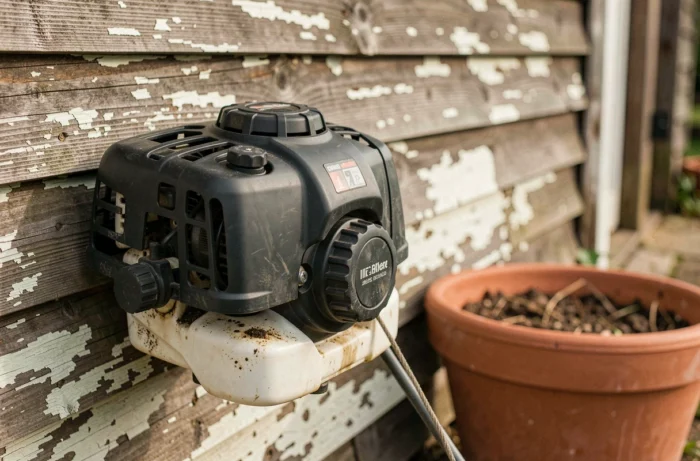
Thermal string trimmer and noise: an underestimated regulatory criterion
Classic buying guides mention noise as a mere comfort inconvenience. The regulatory reality is more stringent, especially for frequent or semi-professional users.
A 2-stroke thermal string trimmer commonly exceeds 95 dB(A) near the user. This noise level quickly places anyone working several hours a day above the daily exposure limit of 85 dB(A) set for workers. The employer is then required to provide hearing protection and take noise reduction actions.
Since the decree of July 30, 2026, the rules for measuring noise exposure at work have been updated, with strengthened controls. For individuals, municipal decrees regulate the hours of use for thermal engine devices, and complaints from neighbors related to the noise of thermal string trimmers are increasing in dense residential areas.
A 4-stroke model drops a few decibels, which does not fundamentally change the situation to the naked ear but may suffice to fall below a regulatory threshold in a professional context. Wearing noise-canceling headphones remains the norm for any use exceeding twenty minutes.
Cutting head and mowing width: choose according to vegetation
The cutting head is the component that determines the finishing quality and versatility of the thermal string trimmer. Two systems coexist.
- The nylon line head remains the standard. The line spins at high speed and slices through grass by impact. Common diameters vary: a thin line is suitable for soft grass, while a thicker line tackles tall grasses and nettles without breaking. Reloading can be manual (spool to fill) or semi-automatic (tap-and-go).
- Plastic knives or blades replace the line on some models. They provide a cleaner cut on short grass and do not wear out as quickly, but they break upon contact with a hard obstacle (stone, concrete edge). Their replacement is more expensive than a spool of line.
- The cutting width, expressed in centimeters, determines the area treated with each pass. A wide cutting width speeds up work on large borders, but makes the device less maneuverable around flower beds and at the base of trees. For versatile use, an intermediate width offers the best compromise.
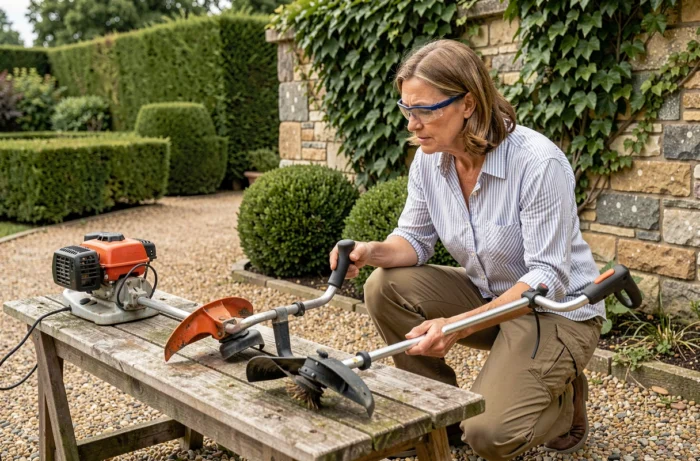
Ergonomics and weight of the thermal string trimmer: the fatigue factor
A thermal string trimmer weighs significantly more than a battery or corded model. This extra weight is felt within the first few minutes, especially in an outstretched arm position on sloped terrain.
Three elements mitigate fatigue:
- The carrying harness distributes the load across the shoulders and hips. On semi-professional models, it is often included. On consumer models, it may need to be purchased separately, and its absence can turn a thirty-minute session into a physical challenge.
- The adjustable handle (D-handle or loop handle) changes the attack angle. A loop handle favors lateral sweeping movements on flat terrain, while a D-handle provides more control in uneven areas.
- The drive shaft (straight or curved) also plays a role. A curved shaft brings the cutting head closer to the ground without straining the back. A straight shaft, which is more robust, is preferred for heavy-duty work and prolonged use.
Testing the device in-store, with the engine off, for two minutes with arms extended gives a better idea of the actual comfort than a technical sheet indicating a dry weight.
Thermal string trimmer or battery: the cases where thermal remains relevant
The decline of thermal among individuals is a documented trend. However, certain uses make it difficult to replace the combustion engine.
Areas larger than one thousand square meters with dense vegetation (brambles, tall grasses, hedge regrowth) require engine torque that batteries struggle to maintain over time. A thermal string trimmer does not lose power throughout the session, whereas a lithium-ion battery sees its performance drop in the last quarter of charge.
Users far from any electrical outlet (isolated plots, rural road edges) have no viable alternative outside of thermal, unless they invest in multiple spare batteries, the cumulative cost of which can exceed that of a complete thermal device.
For a small urban or suburban garden, a battery model covers the vast majority of finishing needs with less noise and zero engine maintenance. The thermal option is justified when the area, vegetation, or lack of electrical network demands it, not as a default choice.