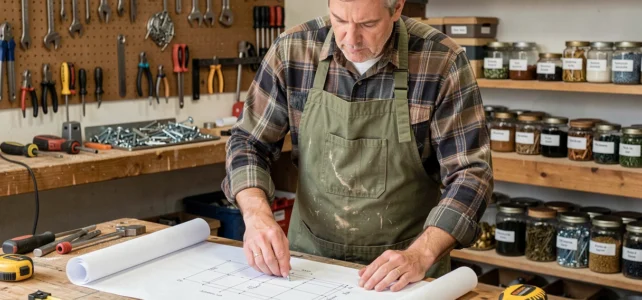
The French DIY market is undergoing a correction phase. After the post-Covid boom, sales in large DIY stores have declined by 4.3% in 2024, reaching 22.1 billion euros according to the 2024 Inodata barometer from the FMB and Inoha. In this context, individuals continue to engage in DIY, but are more selective about their spending. Only 20% of homeowners surveyed claim they can comfortably afford all necessary repairs. Home DIY thus fluctuates between choice and budget constraint.
Private label brands in DIY: an underestimated lever to reduce costs
The rise of private label brands (PLB) in the non-food sector is changing the balance of power. According to a Nielsen analysis published in 2025, PLBs account for 41.4% market share in DIY, with peaks at 58% for drills.
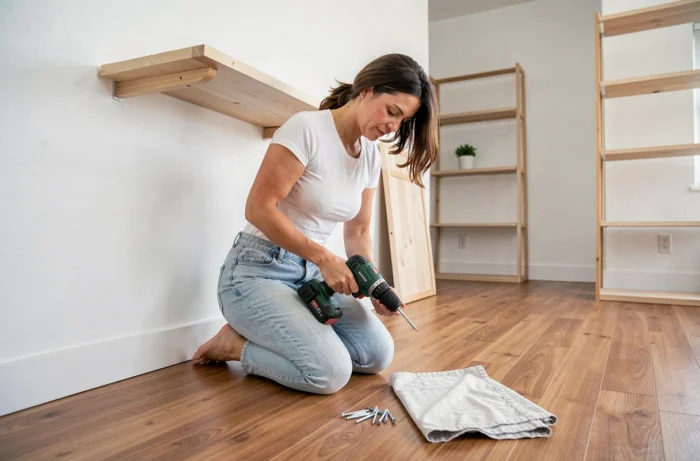
This shift means that a DIY enthusiast who consistently chooses a PLB for their power tools can significantly reduce their budget without sacrificing performance on routine tasks. PLB drills, screwdrivers, and sanders meet the same safety standards as premium brand models.
However, field feedback diverges on this point for specialized tools (routers, precision miter saws). For these ranges, durability and fine adjustment often remain the domain of historical manufacturers. The decision thus depends on the type of project: for installing a shelf or securing a piece of furniture, the PLB is more than sufficient; for a recurring carpentry project, investing in a specialized brand is justified.
To explore practical guides by project type, all pages of Blog du Bricoleur cover a wide range of domestic tasks.
Financing renovation work: available aids and common pitfalls
Launching an ambitious DIY project (insulation, window replacement, bathroom renovation) often requires additional financing. Several schemes exist, but their coordination remains confusing for many individuals.
MaPrimeRénov’ and zero-interest eco-loan
MaPrimeRénov’ remains the main lever for public aid for energy renovation work. The zero-interest eco-loan (éco-PTZ) allows financing of the remaining costs without interest. These two schemes are cumulative, which reduces the actual financial burden.
A point still poorly understood by many individuals: the energy voucher can no longer finance renovation work. This restriction arises from a provision of the finance law of February 14, 2025. DIY enthusiasts who were counting on this supplement for their insulation projects must therefore revise their financing plan.
Advance mutation loan and other options
The advance mutation loan, repayable at the time of the property’s sale, targets low-income homeowners who cannot afford monthly payments. It remains little known and unevenly distributed among banking institutions.
- Check eligibility for MaPrimeRénov’ before starting work, as criteria regularly evolve and procedures must precede the start of the project.
- Request a quote that meets RGE (Recognized Environmental Guarantee) requirements for the craftsman, a sine qua non condition to unlock most aids.
- Compare the total cost of an eco-PTZ with a traditional work loan, as depending on the amount and duration, the cost difference can be modest.
Safety on domestic worksites: risks that tutorials do not show
Online DIY videos show the results, rarely the accidents. The construction and works sector (including finishing work) has one of the highest workplace accident rates in France. While these figures concern professionals, individuals face the same risks with less training and often insufficient protective equipment.
The most accident-prone areas in home DIY are cutting (circular saw, grinder), working at height (ladder, step stool), and handling chemicals (strippers, glues, solvents).
- Always wear protective goggles during any cutting or drilling, even for a task lasting a few seconds.
- Use a ladder compliant with EN 131 standards rather than a chair or stool, the leading cause of domestic falls during work.
- Work in a ventilated space whenever a product bears a hazard pictogram, and wear at least an FFP2 mask for fine dust (sanding, cutting sheets).
- Turn off the power at the circuit breaker before any intervention on a circuit, even to replace a socket.
Chosen DIY or constrained DIY: what the market decline reveals
The decline in sales in large DIY stores does not indicate a disinterest among the French in “do-it-yourself.” It rather reflects a tighter financial arbitration between comfort projects and necessary repairs. When the budget tightens, beautification work (decorative painting, terrace layout) takes a back seat to urgent repairs (leak, broken shutter, failing insulation).
This distinction between chosen DIY and constrained DIY also sheds light on the success of PLBs: buying cheaper to continue DIYing despite inflation. Brands that understand this are strengthening their entry-level ranges and developing smaller formats (reduced paint packaging, single-project kits).
DIY remains a sought-after domestic skill, but the ability to finance projects now determines their scope. Identifying available aids, choosing the right level of tool range, and not neglecting safety are three concrete axes that condition the success of a project, well before the choice of a video tutorial.