
Staying active after 60 is no longer just about choosing between Nordic walking and crossword puzzles. Since the pension reform of 2023, an increasing number of 60-64 year-olds remain employed, redefining the boundary between professional life and retirement. This reality changes the way we think about activity, health, and daily balance at this age.
Employment of 60-64 year-olds after the pension reform: game-changing figures
Content about retirement rarely addresses the evolution of the job market for seniors. Recent data tells a different story.
According to a note from Dares reported by Le Monde on July 29, 2026, the proportion of people aged 60 to 64 in employment reached an unprecedented level in 2025, with a gain of 8.2 points over three years for this age group. Dares attributes this change “in part” to the pension reform of 2023.
This shift has direct consequences on how retirement is experienced. Many seniors now combine part-time work with a gradual retirement, altering their rhythm, budget, and relationship with their bodies.
| Indicator | Before reform (2022) | After reform (2025) |
|---|---|---|
| Employment of 60-64 year-olds | Reference level | +8.2 points in three years |
| Use of gradual retirement | Minority | Significantly increased since 2025 |
| Effective age of cessation of activity | Earlier | Pushed back by several quarters |
The table highlights a gap between traditional advice (“enjoy your free time”) and the reality of many seniors who have not yet left the workforce. Resources like jeune-senior.net document this transition between professional activity and full retirement.
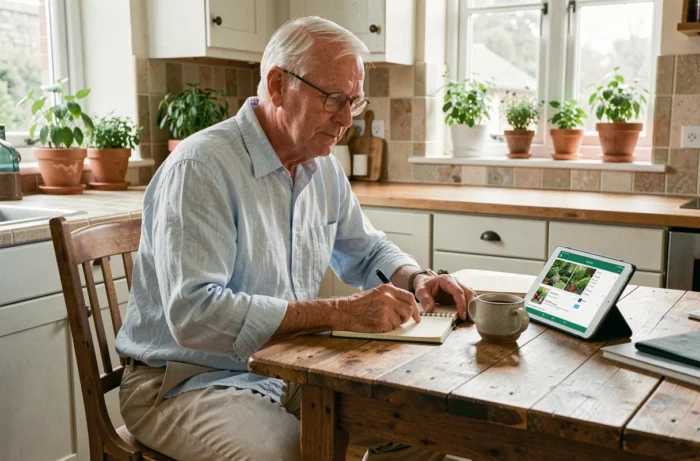
Gradual retirement and partial activity: an underestimated lever for health
Gradual retirement allows individuals to reduce their working hours while receiving a portion of their pension. Since the age for accessing this scheme has been adjusted, the number of applications has significantly increased between 2025 and 2026.
This mechanism has a rarely mentioned advantage in health guides: it maintains a structured framework. The abrupt transition from full-time work to total inactivity is associated with an increased risk of sedentariness and social isolation.
Why a smooth transition better protects the body and memory
Maintaining professional activity, even reduced to a few days a week, imposes a regular lifestyle. Getting up at a fixed time, commuting, interacting with colleagues: these light constraints act as a foundation for daily movement and cognitive stimulation.
- Maintaining regular professional interactions slows the decline of working memory, which is constantly engaged in a professional context
- Commutes, even short ones, add minutes of physical activity that most leisure programs do not fully compensate for
- The sense of social usefulness linked to a professional role contributes to mental balance, a factor that volunteering alone does not always replace
Gradual retirement thus functions as a protective transition between employment and full retirement.
Sedentariness after 60: the real risk does not come from lack of exercise
Most advice for seniors emphasizes structured physical activity (group classes, swimming, yoga). The problem lies elsewhere: it is the time spent sitting that most degrades health, regardless of exercise sessions.
A person who walks for 30 minutes in the morning but remains seated for the rest of the day does not offset the effects of prolonged sedentariness. Research clearly distinguishes between “physical inactivity” (not exercising enough) and “sedentariness” (remaining still for too long).
Breaking sedentariness without a sports program
The goal is not to add additional physical activity but to break up periods of immobility. Standing up every 30 to 45 minutes, walking while on the phone, gardening in short bursts: these micro-interruptions have a measurable effect on blood sugar and circulation.
For retirees who maintain partial activity, commutes and active breaks are often sufficient to reach this threshold. For those in full retirement, structuring the day around short trips advantageously replaces a rigid sports program.
Mental balance and social life in retirement: what invisible breaks produce
The transition to full retirement is accompanied by three breaks that can accumulate within a few months: the end of the professional framework, geographical distance from children, and the natural reduction of the social circle with age.
Each of these breaks reduces the number of daily social interactions. Below a certain threshold, the risk of chronic isolation significantly increases, with documented consequences on cardiovascular and cognitive health.
Regular and structured activities rather than spontaneous sociability
Common recommendations suggest “going out more” or “reconnecting with old friends.” In practice, spontaneous sociability decreases with age because opportunities for unplanned meetings disappear.
- Fixed-schedule activities (classes, workshops, associations) create recurring interactions with the same people, fostering the building of lasting bonds
- Regular collective commitments (weekly volunteering, walking groups, choirs) require leaving the home even on days of low motivation
- Intergenerational activities expose individuals to more varied cognitive exchanges than groups composed exclusively of peers of the same age
The regularity of engagement matters more than its nature. A bike repair workshop on Tuesday morning better protects against cognitive decline than an annual trip.
Data on senior employment shows that the boundary between “active” and “retired” is blurring. The 8.2-point gain in employment among 60-64 year-olds over three years reflects a structural change, not a temporary adjustment. For those who leave work permanently, recreating a regular and demanding activity framework remains the most effective lever for preserving physical health, memory, and social connection.