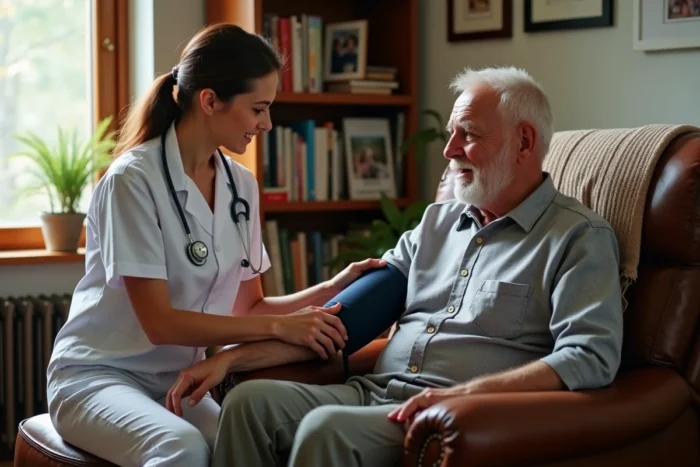
After a knee operation, an elderly person returns home with a prescription for daily dressings and anticoagulant injections. Two options arise: returning each day to a care facility or receiving a nurse’s visit directly at home. The home nursing practice addresses this second option, and its benefits far exceed the simple time saved on transportation.
Independent nursing practice or SSIAD: a distinction that changes care timelines
You may have heard of SSIAD, these home nursing services funded by Health Insurance? Their coverage is comprehensive, but spots are limited. The wait time before actual care begins can reach up to ten days, which poses a real problem upon returning from hospitalization.
An independent nursing practice operates differently. The nurse often visits as soon as the next day after the request. The responsiveness of an independent practice prevents gaps in post-hospitalization care. This difference in timing may seem trivial, but for a surgical dressing or a daily injection, every day counts.
SSIAD primarily targets individuals over 60 who are dependent or suffering from chronic conditions. An independent nursing practice, on the other hand, remains open to all profiles: young adults post-operation, parents of infants requiring specific care, patients with long-term illnesses (ALD), or even individuals undergoing infusion treatment.
More details on these distinctions can be found about Construire la Bretagne, which addresses the issue from a Breton territorial perspective.
Continuity of home nursing care: why the same face matters
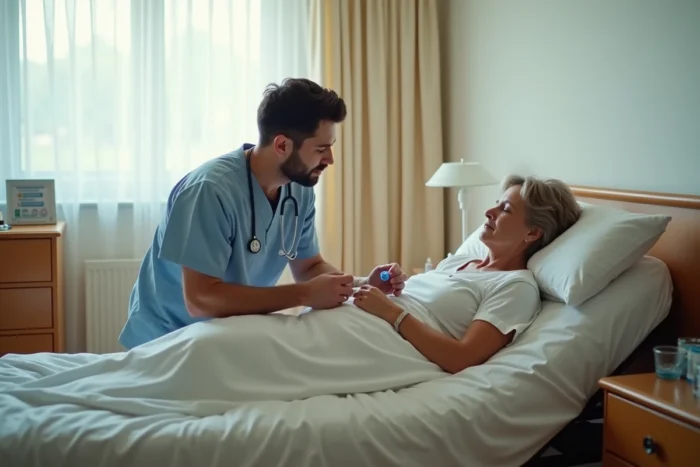
In a hospital setting, teams rotate. A patient may see three or four different nurses in a week. At home, the logic is reversed.
With a local nursing practice, the patient is followed by a limited number of professionals, often the same ones from visit to visit. This stability has a direct effect on the quality of follow-up. The nurse knows the history, spots an unusual redness around a dressing, notes a change in behavior.
Regular follow-up by the same caregiver allows for earlier detection of complications. Let’s take a concrete example: a diabetic patient on insulin therapy. If the nurse who visits every morning notices that blood sugar levels are gradually drifting, she alerts the attending physician before the situation deteriorates. In a traditional hospital circuit, this micro-evolution would easily slip through the cracks.
The link with the attending physician and pharmacist
The independent nurse works in direct coordination with the attending physician and the local pharmacy. This trio forms a network of local health care. The prescription is shared, feedback is quick, and the patient does not need to play the role of messenger between professionals.
Recently, it has even become possible to designate a referent nurse within the framework of an ALD, formalizing this coordination and strengthening the nurse’s role in the patient’s care pathway.
Technical care that can be performed at home: much more than dressings
Sometimes, the role of the home nurse is reduced to injections and dressings. The reality is much broader. Here are the common procedures that an independent nursing practice can perform directly at the patient’s home:
- Intravenous or subcutaneous infusions, including for antibiotic treatments or parenteral nutrition, without requiring home hospitalization (HAD)
- Complete post-operative monitoring: suture removal, drainage, vital signs control, and pain assessment
- Palliative care in coordination with the medical team, allowing the patient to remain in their environment until the end
- Therapeutic education for chronic patients (diabetes, heart failure), including learning self-monitoring
Complex care such as infusion does not always require HAD. This is a point that many families are unaware of. When the patient’s condition allows and the protocol is well defined, the independent nurse can manage the infusion at home in connection with a coordinating nurse, without mobilizing the heavy resources of home hospitalization.
Financial coverage of home nursing care
The procedures performed by an independent nurse are prescribed by a physician and reimbursed by Health Insurance according to the current nomenclature. With complementary health insurance, the out-of-pocket cost for the patient is often zero.
The difference with an SSIAD lies in the billing method. The SSIAD operates with a global budget, while the independent nurse bills per act. For the patient, the financial outcome is comparable, but the flexibility of access is significantly greater on the independent side.
Case of patients with ALD
For patients recognized as having a long-term illness, nursing care related to the condition is covered 100% by Health Insurance. This includes both daily injections and regular monitoring or therapeutic education. The designation of a referent nurse facilitates administrative and medical follow-up.

Data security and obligations of the nursing practice
A rarely discussed aspect concerns the management of health information. Independent nursing practices handle sensitive data: hospital reports, biological results, care protocols. They are subject to the same security obligations as other health professionals.
The nursing practice must guarantee the confidentiality of patient data in accordance with the current regulatory framework. This includes the use of approved management software, secure storage of files, and traceability of procedures. For the patient, this is a guarantee that their medical information does not circulate chaotically.
Thus, resorting to a home nursing practice combines responsiveness, technicality, and relational proximity. For patients whose condition does not justify prolonged hospitalization, it is an alternative that preserves both autonomy and the quality of care received.