Choosing your outdoor equipment involves balancing three often contradictory variables: the total weight carried, protection against encountered conditions, and the available budget. Most online guides address these criteria separately, item by item. Comparing these three parameters simultaneously, for each category of equipment, provides a more useful overview before making a purchase.
Weight, protection, and price: comparison by category of outdoor equipment
The table below summarizes the typical trade-offs for the four main categories of outdoor equipment (day hikes or multi-day trips).
| Category | Average weight carried | Level of protection | Price range |
|---|---|---|---|
| Shoes (low cut) | Light | Moderate (limited ankle support) | Entry-level to mid-range |
| Shoes (high cut) | Heavier | High (ankle support, rigid sole) | Mid-range to high |
| Backpack 20-30 L (day) | Light | Standard (no integrated cover) | Entry-level |
| Backpack 40-60 L (multi-day) | Medium | High (waist belt, back frame) | Mid-range to high |
| Waterproof jacket (2-layer membrane) | Light | Moderate (limited breathability) | Entry-level |
| Waterproof jacket (3-layer membrane) | Light to medium | High (breathability and waterproofing) | High |
| Freestanding tent (2-person) | Heavy | High (4-season possible) | Mid-range to high |
What stands out: extra protection always costs weight or budget, rarely both at the same time. A high-cut shoe protects the ankle but adds weight to each step. A 3-layer membrane breathes better than a 2-layer, but the price rises quickly.
Determining your priorities before looking at product sheets helps avoid unbalanced purchases. To delve deeper into each category and find suitable references, the equipment on L’Esprit Nature details the technical characteristics by use.
Shoes and technical clothing: where comfort really matters
Competitors often list shoes and clothing separately. The important point is their interaction with the terrain and weather, not their isolated description.
Shoes: low or high cut depending on elevation
On marked trails with little elevation, a low cut is sufficient and reduces muscle fatigue over long distances. As soon as the terrain becomes technical (scree, steep passages, residual snow at the beginning or end of the season), a high cut stabilizes the ankle joint.
The outsole deserves as much attention as the upper. A deep tread grips on wet ground but wears out faster on asphalt. Adapting the sole to the main expected terrain extends the shoe’s lifespan.
Clothing: the three-layer system remains the reference
Layering works because it allows for thermal regulation adjustments without changing everything:
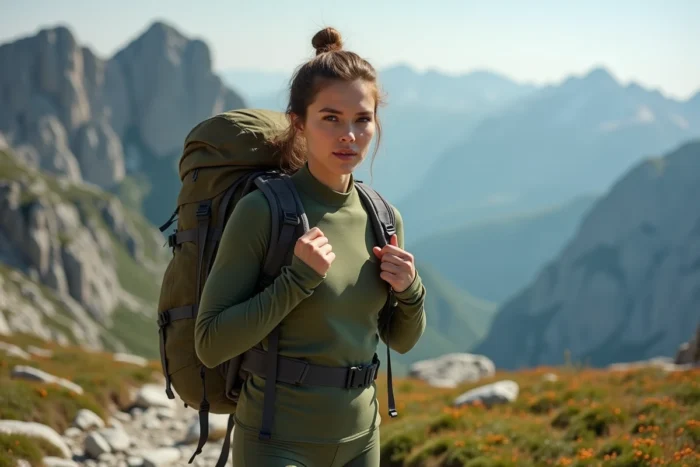
- Base layer (technical underwear): wicks away sweat. Synthetic fibers dry quickly, while merino wool regulates temperature better but dries more slowly.
- Mid layer (fleece or softshell): insulates from the cold. The choice depends on the intensity of the effort; a light fleece is suitable for active walking, while a thicker model is better for breaks at altitude.
- Outer layer (waterproof jacket): protects from wind and rain. A breathable membrane prevents internal condensation that negates the benefits of waterproofing.
In summer, the mid layer stays in the bag. In transitional seasonal conditions, it makes the difference between comfort and progressive hypothermia.
Hydration and navigation: two underestimated aspects of outdoor outings
Recent content on outdoor equipment increasingly emphasizes two topics that traditional gear lists treat in a single line: water management and navigation tools.
Water reserve and purification based on thermal exposure
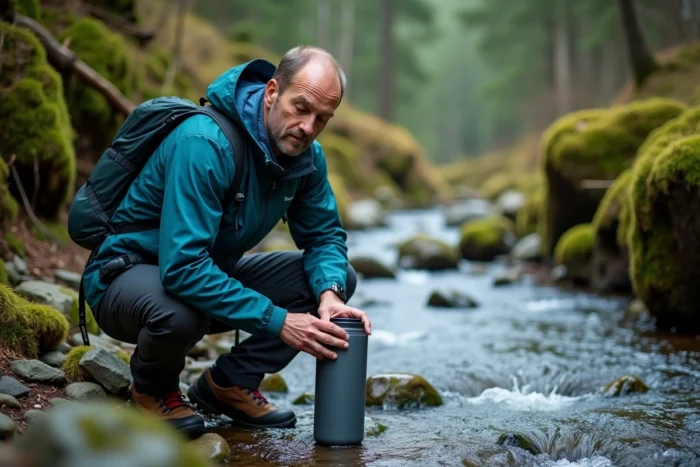
The amount of water needed varies greatly depending on heat and the absence of resupply points. In hot weather, consumption increases significantly, and a route without a reliable source requires carrying a larger reserve or a purification system (filter, tablets, UV).
Planning for a purification solution reduces the weight of water carried while ensuring access to drinking water if the route crosses a watercourse. This is a direct weight/safety trade-off.
Redundancy in navigation tools
On marked trails, a smartphone with a mapping app is usually sufficient. Once the route goes off marked paths, redundancy becomes a safety criterion: a paper topographic map, compass, and external battery in addition to GPS.
Battery failure remains the leading cause of avoidable disorientation. An external battery with enough capacity to recharge the phone at least once covers most multi-day outings.
Versatile equipment: a selection criterion gaining ground
Recent guides highlight versatility as a selection filter, especially for accessories. The reasoning is simple: each item that serves two functions is one less item to carry.
Some concrete examples of this logic:
- Collapsible trekking poles that double as poles for a lightweight tent or tarp, eliminating the need to carry separate poles.
- Headlamp with a diffuse lantern mode, usable at camp without adding a second light source.
- Reusable emergency blanket that also serves as an improvised ground mat for a meal break.
This versatility criterion also applies to clothing: a windproof and water-repellent softshell can replace both the mid layer and the outer layer in dry and cool weather.
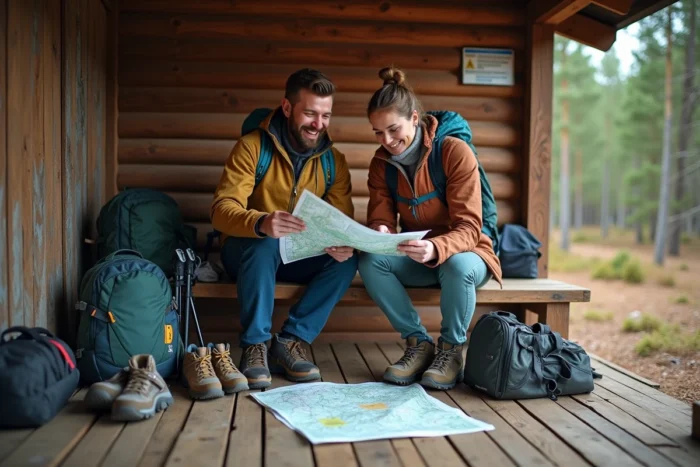
The final trade-off between weight, protection, and budget depends on the duration of the outing and the desired level of autonomy. For a day on a marked trail in summer, lightweight and inexpensive equipment fulfills the contract. For a multi-day expedition with self-navigation, investing in shoes, the outer layer, and navigation tools provides the best safety/comfort ratio. The rest can be gradually supplemented, outing after outing.