
In sixth grade, written expression represents an important part of the French curriculum. Students must write various texts, from adventure stories to character portraits, including letters or dialogues. Working from corrected writing prompts in PDF format allows students to understand what is concretely expected in a paper, and especially to progress between two assessments.
Writing in 6th Grade: What the Curriculum Really Requires
Sixth grade belongs to cycle 3, which means it directly extends the learning from CM1 and CM2. The program resulting from the decree of April 17, 2025 places writing at the center of the French course with a specific requirement: to produce written work very frequently, not just during tests.
Specifically, students must write short texts in each session and longer texts each week. This frequency often surprises families used to a monthly writing rhythm in primary school.
The official framework also emphasizes the writing process itself. Planning the text, drafting, revising to correct and improve, then producing a polished version: these steps are part of the evaluation. A PDF correction that shows only the final result, without explaining the process, misses this logic. Looking for writing prompts with PDF corrections for 6th grade helps to break down each step, from the draft to the final text.
Working on Written Expression with a PDF Correction: The Method That Works
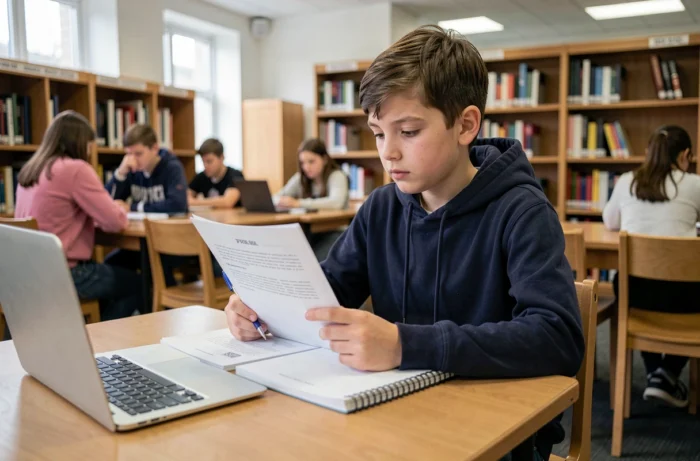
Downloading a corrected prompt is useless if one simply reads the correction. The exercise becomes useful when it is used in three stages.
First, write without looking at the correction. The student reads the prompt, thinks about their ideas, organizes their text on a draft, then writes their version. This first draft, even if imperfect, is the raw material for the work.
Next, compare with the correction. Not to copy, but to identify discrepancies. Here’s what to observe:
- The structure of the text: does the correction include an introduction, distinct paragraphs, a clear ending? If the student’s text forms a single block, that’s the first point to correct.
- The vocabulary: does the correction use more precise words or synonyms that the student hadn’t found? Noting these words in a notebook helps to enrich their lexicon.
- Conjugation and agreements: errors in tense (simple past, imperfect) or subject-verb agreement are the most frequent in sixth grade. The correction allows for checking each verb.
- Instructions followed: did the prompt ask for a story in the past? A dialogue? A first-person narrator? The correction shows how each instruction translates into the text.
The third stage consists of rewriting one’s own text by integrating what has been identified. This rewriting phase is where real progress occurs.
Common Writing Prompt Types in 6th Grade French
The prompts offered in sixth grade revolve around a few major categories related to the reading curriculum. Knowing these categories helps to avoid being caught off guard on test day.
The Adventure Story or the Fairy Tale
The prompt often asks to write the continuation of a text read in class, or to invent an episode in a given universe. The main difficulty is maintaining the coherence of the narrative: past tense, characters that remain true to their description, logical sequence of actions.
A common pitfall: mixing simple past and compound past in the same text. Well-constructed PDF corrections highlight this error and show how to alternate imperfect (for descriptions) and simple past (for actions).
The Portrait or Description
Describing a place or a character requires rich vocabulary and spatial or logical organization. Students tend to accumulate adjectives without ordering them. A good correction shows how to structure a description from general to specific, or from physical traits to character for a character.
The Dialogue Embedded in a Narrative
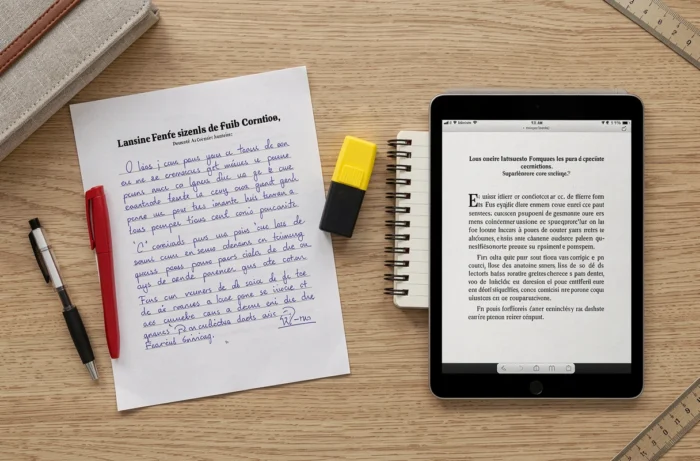
This type of prompt combines narration and direct speech. The punctuation of dialogue (quotation marks, dashes, speech verbs) often poses problems. Working on an annotated correction allows students to memorize the presentation rules, which are evaluated as much as the content.
Recurring Errors in 6th Grade Writing and How to Correct Them
Some errors appear in the majority of sixth-grade papers. Identifying them early prevents them from becoming ingrained.
The absence of paragraphs is the most visible. Many students write everything in one block, without line breaks. The rule is simple: a new idea, a new place, or a new moment in the narrative calls for a new paragraph.
Excessive repetitions come in second. “He did,” “he said,” “he saw” follow one another without variation. Working with a correction that offers alternatives (“he accomplished,” “he murmured,” “he glimpsed”) enriches writing in a concrete way.
The third common error concerns partial off-topic writing. The student starts by following the prompt, then drifts off. Rereading the prompt after writing the draft allows for checking that no requested element has been forgotten or that no unnecessary passage has been added.
Downloading PDF Sheets: Criteria for Choosing Useful Resources
Not all PDFs available online are equal. Before downloading, check a few points.
- Is the correction detailed or does it limit itself to a model text without explanation? A correction that comments on writing choices (why this tense, why this connector) provides more value.
- Do the prompts correspond to the current 6th-grade curriculum? Sheets dating back more than ten years may offer exercises that are out of sync with the current expectations of cycle 3.
- Is the language level of the correction accessible to an eleven or twelve-year-old student? A model text that is too literary discourages more than it helps.
The most effective sheets combine a prompt, an example of an organized draft, and a written correction with margin annotations. This format replicates the process expected by teachers: plan, write, revise.
Regularity matters more than quantity. Working on a corrected prompt each week, following the three-stage method described above, produces visible results in a few weeks regarding the quality of papers submitted in class.