The surface area of a pool determines part of its tax regime, but not in the way most owners imagine. The threshold of 10 m², often presented as a boundary between taxable and non-taxable pools, actually falls under urban planning law. Its impact on property tax or development tax follows different criteria.
Understanding these non-taxable pool dimensions involves untangling what pertains to the declaration at the town hall, the cadastral rental value, and the fixed or removable nature of the installation.
Threshold of 10 m²: urban planning, property tax, and development tax compared
The table below summarizes the fiscal and administrative treatment of a pool based on its surface area and nature. It highlights the discrepancies between the three overlapping regimes.
| Criterion | Removable above-ground pool < 10 m² | Removable above-ground pool ≥ 10 m² | Buried or fixed pool < 10 m² | Buried or fixed pool ≥ 10 m² |
|---|---|---|---|---|
| Prior declaration at the town hall | No | Yes (if installed more than 3 months/year) | No | Yes |
| Development tax | No | Possible depending on installation duration | No | Yes |
| Property tax (rental value) | No | No (if truly removable) | Yes | Yes |
The most revealing line concerns property tax. A buried pool of less than 10 m², such as a shell mini-pool, remains a fixed structure that increases the cadastral rental value. The 10 m² threshold does not protect against property tax: it only exempts from prior work declaration at the town hall.
Before going further, it should be noted that the non-taxable pool dimensions to know depend as much on the nature of the pool as on its gross surface area.
Removable above-ground pool: cumulative exemption conditions
Evading both the development tax and property tax does not rely on a single characteristic. Several criteria must be met simultaneously for a pool to be considered non-taxable.
- The pool must be truly removable without demolition work: a tubular, inflatable, or kit structure that can be removed in a few hours meets this criterion, not a shell placed in a concrete pit.
- The installation must not remain in place for more than three consecutive months per year. Beyond that, the administration can reclassify the pool as a permanent construction subject to declaration.
- No fixed connection to the water or electricity network should exist. A temporary connection via a garden hose differs from an underground pipeline connected to the home’s filtration system.
- The pool must not be surrounded by permanent fixtures (masonry coping, attached terrace poured on a slab) that betray a permanent character.
Failure to meet even one of these criteria is enough to render the pool taxable. The duration of presence and ground attachment have become the decisive elements for the tax administration, even more so than the surface area.
Development tax on buried pools: what the surface triggers
For buried or fixed pools of 10 m² and more, the development tax applies at the time of construction. It is calculated based on the surface area of the pool declared in the permit or prior declaration. The fixed value per square meter is set annually at the national level, then multiplied by municipal and departmental rates.
This tax is due only once, upon completion of the work. In contrast, property tax recurs annually since it results from the permanent increase in the property’s rental value.
Temporary exemption from property tax after construction
A buried pool declared on time (within 90 days of completion) may benefit from a two-year exemption from property tax. After this period, the increase applies permanently. Failing to declare does not eliminate the tax: it delays it and exposes one to late penalties.
Detection of undeclared pools: tax control by imaging
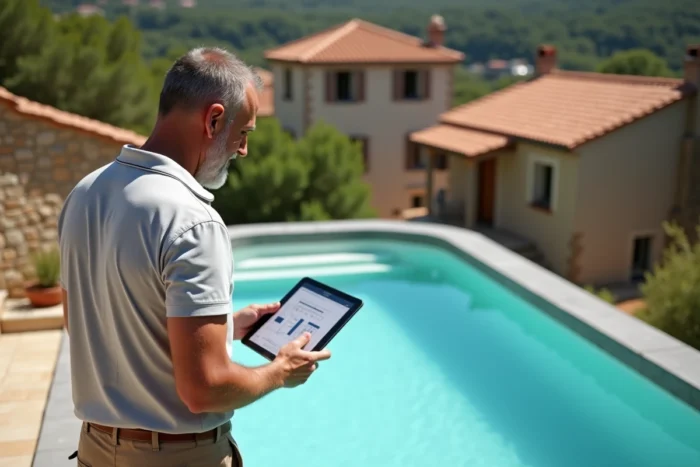
The tax administration now uses aerial imaging combined with artificial intelligence to spot undeclared pools. This system compares satellite photos with cadastral data and identifies constructions absent from the records.
This system does not distinguish between an above-ground pool and a buried pool in an aerial photo. A tubular pool left in place all year can therefore trigger a report. The owner will then have to prove the removable and temporary nature of their installation.
Sanctions for non-declaration include the recovery of taxes owed over several years, along with increases. Declaring within 90 days remains the only reliable protection, even for a pool that one thinks is exempt.
Pool surface area and taxable surface area: a distinction not to be confused
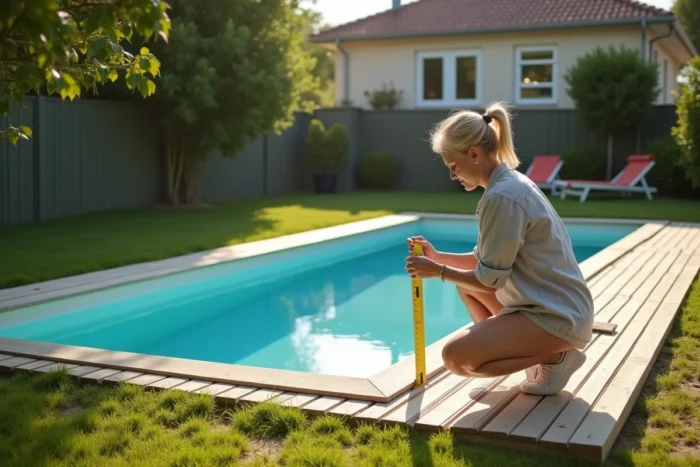
The surface area considered for the development tax corresponds to the interior footprint of the pool, measured at the waterline. Copings, beaches, and technical rooms do not enter into this calculation for the development tax, but they can influence the rental value retained for property tax.
A free-form pool with curves or integrated stairs sees its surface calculated based on the actual footprint, not according to an encompassing rectangle. This nuance can represent a significant difference in the final amount of the development tax.
The determining criterion for avoiding any taxation is therefore not simply to stay under 10 m². Only a removable, non-fixed above-ground pool installed for less than three months per year escapes all taxes. For any other type of pool, taxation applies as soon as the construction is completed and declared, regardless of the pool’s surface area.