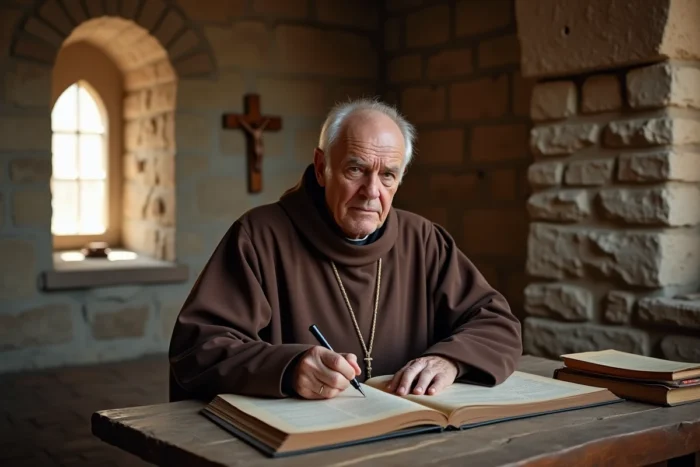
A Catholic monk who enters the monastery does not sign an employment contract and does not receive a payslip. The question of a monk’s salary comes up regularly, often confused with the compensation paid to diocesan priests. The reality is more radical: the vow of poverty places the monk in a framework where the very notion of individual income disappears.
Vow of poverty and communal life: what it changes concretely
When we talk about the salary of a diocesan priest, we refer to a personal allowance paid each month. For a monk, the mechanism is fundamentally different. By taking the vow of poverty, he legally renounces personal ownership of his income.
In practice, if a monk receives a pension, royalties, or payment for outside work, these amounts are paid directly to the abbey. The money does not pass through a personal account. In return, the community takes care of housing, food, medical care, social protection, and a very small allowance.
One can learn more about a monk’s salary to measure the gap with the compensation of priests, who receive an individual allowance of around 1,000 euros net per month depending on the dioceses.
The monk, on the other hand, receives nothing comparable. His living framework relies on a collective functioning where every material need is covered by the community, not by a monthly bank transfer.

Monks employed externally: an unknown case
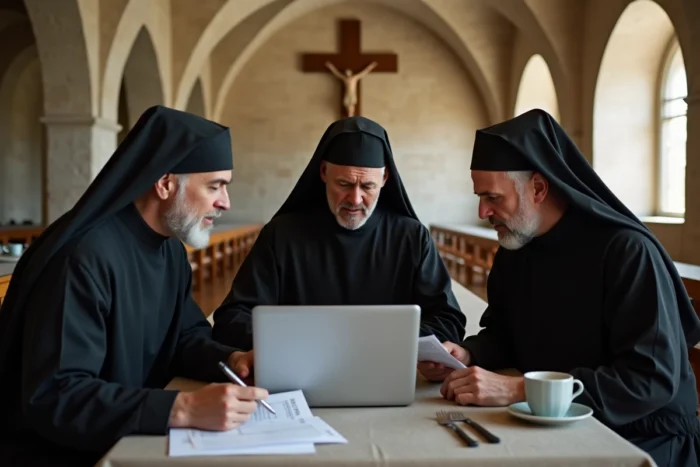
Some monks hold a regular job outside the monastery. Teaching, IT, nursing: these situations exist in several Western abbeys. The monk then signs an ordinary employment contract, with a proper payslip.
The difference comes after the payment. The salary is canonically considered to belong to the religious institute, not to the monk as an individual. The vow of poverty does not disappear because there is an external employer. The abbey collects the payment, and the monk continues to live according to the same rules as his brothers who remained in the monastery.
Feedback on this point varies among communities: some allow a little latitude for personal expenses, while others apply the principle strictly. The canonical framework remains the same, but daily practice depends on each abbey.
Monastery revenues: breweries, cheesemaking, and e-commerce
If monks earn nothing individually, monasteries themselves sometimes generate significant revenues. Since the 2010s-2020s, many European abbeys have structured real economic activities.
- Monastic breweries that produce and sell beer under recognized brands, with sometimes national distribution
- Cheesemaking, cosmetics workshops, jams, and other artisanal products sold on-site or online
- Hospitality and hosting of retreatants, with variable rates depending on the establishments
- Online shops (e-commerce) that allow expanding the customer base well beyond the local area
These activities are subject to common law: VAT, corporate tax, competition rules. A monastery that sells cheese is fiscally treated as a business for this part of its activity. The profits are used to maintain the buildings, finance community life, and sometimes support charitable works.
The monk who works at the cheesemaking or shop does not receive a share of the sales. He participates in the productive activity as he participates in prayer: it is a component of monastic life, not a paid job.
The question of social protection
Monks benefit from social coverage, but under a specific regime. In France, they are affiliated with CAVIMAC (Caisse d’assurance vieillesse, invalidité et maladie des cultes), the same organization as priests. Contributions are paid by the community.
A monk’s retirement pension is very modest, often lower than that of a diocesan priest. This pension, like any other income, goes to the abbey. The retired monk continues to live in the monastery under the same material conditions as during his active life.
Catholic monk and diocesan priest: two distinct financial realities
The confusion between monk and priest arises in almost all inquiries about remuneration within the Catholic Church. The table below summarizes the structural differences.
| Criterion | Diocesan Priest | Catholic Monk |
|---|---|---|
| Individual Income | Personal monthly allowance | No personal income |
| Housing | Rectory provided by the parish | Cell at the monastery |
| Vow of Poverty | Not required | Mandatory |
| Economic Activity | Parish ministry | Community or external work (salary paid to the community) |
| Retirement | Personal pension via CAVIMAC | Pension paid to the community |
A diocesan priest manages his personal budget, even if modest. A monk simply does not have a budget to manage. The total care provided by the community makes the question of “how much does a monk earn” almost irrelevant: the technical answer is zero euros of individual income.
This functioning may seem austere from the outside. For the communities involved, it is a structuring life choice where the economic dimension is deliberately erased in favor of the collective. The monk who makes soap, teaches Latin, or cultivates a vegetable garden does not work for a salary; he works so that the abbey continues to exist.